
Reactive Dog Training: How to Reduce Reactivity on Walks
 Written by
Navigating the world with a reactive dog can feel incredibly stressful, turning what should be a peaceful stroll into a tense journey. This guide offers a practical approach to reactive dog training, focusing on methods that help your dog feel safer and more secure.
You’ll learn science-based techniques like Desensitization and Counter-Conditioning (DS/CC) to reduce overreactions and build calmer habits over time. If you’re working toward an ESA letter, this kind of structured training and management plan also supports a more stable day-to-day routine — something many owners find helpful when documenting progress and ongoing support needs.
Reactive Dog Meaning: What Does “Reactive Dog” Mean?
A reactive dog exhibits an overreaction to normal situations, showing big feelings or an intense emotional state to everyday occurrences.
Your dog is living in a constant state of stress, often displaying stressful situations with barking, lunging, or freezing. The reactive dog meaning differs from aggression, which describes an intent to cause harm.
Understanding what a reactive dog means helps you address their reactive behavior effectively.
What Causes Reactivity In Dogs?
Reactivity often stems from an accumulation of stressors, a phenomenon called trigger stacking. Each small stressor adds to your dog’s overall anxiety, leading to an eventual outburst. Fear and frustration are the primary drivers behind what causes reactivity in dogs, and punishment intensifies fear-based reactions, making behavior worse over time.
This matters even more if your dog is an emotional support animal, since day-to-day stability and predictable behavior are part of what helps them support you. Understanding your dog’s triggers is the starting point for successful reactivity training.
Reactivity In Dogs: Common Triggers
Various stimuli can act as dog triggers, initiating a reactive response in your dog. These triggers are specific to each dog, based on their individual experiences and sensitivities. Your dog’s reaction is an emotional response to the presence of these stimuli.
- Strangers represent a common trigger for many reactive dogs, often leading to displays of reactive to strangers behavior.
- Other dogs frequently act as triggers, causing dog-directed reactivity during walks or in public spaces.
- Specific environmental stimuli, such as skateboards, bicycles, or sudden loud noises, also provoke reactive behaviors.
- Reactivity often manifests through physical behaviors like lunging, barking, and growling, indicating your dog is overwhelmed. Understanding these signals prevents trigger stacking, where multiple stressors overwhelm your dog.

How To Train A Reactive Dog: The Beginner-Friendly Training Plan?
1. Before Training: Safety + Management
You can’t train effectively while your dog is actively exploding. Management is what keeps your dog under threshold so learning can happen. That often means walking at quieter times, choosing low-traffic routes, avoiding tight “trap zones,” and using distance like a real tool—not as a last resort. If you need it, use visual blocks (cars, hedges, turning behind a barrier) to prevent your dog from locking onto the trigger.
Equipment helps too. A front-clip harness gives control without pain, and having high-value treats ready stops you from winging it when things get tense.
2. The Emergency U-Turn (Your “Exit Button”)
Teach a cue like “Let’s go!” that means “turn and move fast with me.” Start somewhere calm: say the cue, turn, and feed a few treats while you move away. Practice until it becomes automatic, then use it on walks before your dog erupts.
3. Threshold & Distance
The threshold is the point where your dog can’t think, only react. Under threshold means your dog notices the trigger but can still take treats and respond to you. A simple rule: if your dog won’t take high-value treats, you’re too close.
If your dog reacts to other dogs at around 10 meters, start training at 20–30 meters. Training happens where your dog can succeed, and you shrink distance gradually as your dog stays calm more consistently. Remember that threshold changes with stress; on a rough day, your dog may need more space.
4. Ds/Cc (Desensitization + Counter-Conditioning) — The Core Method
This is the backbone of dog reactivity training: teach your dog that triggers predict good things, not danger.
Order matters. When the trigger appears, treats start. When the trigger disappears, treats stop. You’re building a clean emotional association: trigger = good stuff.
Here’s the simple loop: begin far enough away that your dog stays calm, then feed high-value treats the moment your dog notices the trigger. Keep it going for a few seconds while the trigger is present, and stop as soon as it’s gone. Repeat many short reps over days and weeks, only decreasing distance when your dog is consistently relaxed at the current level.
Your dog doesn’t need to sit or “behave” to earn the reward. In this phase, the reward is for staying under the threshold while the trigger exists.
Outside of trigger moments, simple foundation cues like how to teach a dog to sit can still help build focus and communication — but distance and timing come first when reactivity is happening.
5. One Game That Works: Engage–Disengage (Look At That)
This game teaches your dog: “I can notice the trigger… then come back to my human.”
Let your dog glance at the trigger, mark it with a calm “Yes!”, and reward when your dog turns back to you. Start far away and keep it easy. Over time, the trigger becomes a cue to check in, not a reason to explode.
Training in Real-Life Scenarios
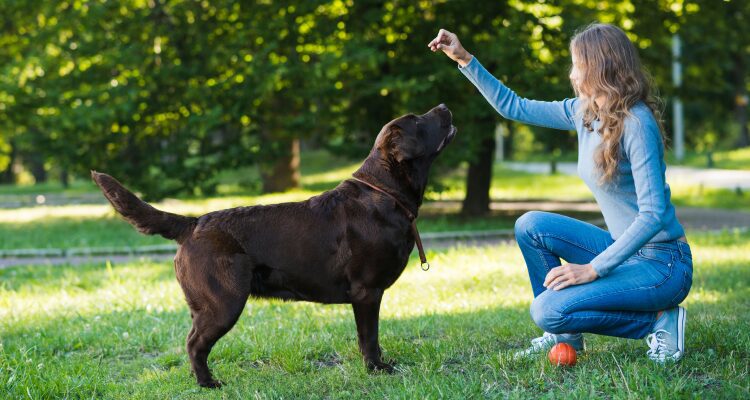
Once your dog has mastered foundation skills, it’s time to practice in real-life scenarios where triggers are present. This step is essential for helping your reactive dog generalize their training and respond calmly in everyday situations. Start with short walks in quiet locations, gradually increasing the intensity and complexity as your dog becomes more comfortable.
Pay close attention to your dog’s threshold and be ready to adjust the distance or take breaks if you notice signs of stress. Management techniques, such as using a front-clip harness or head halter, can be helpful for reducing pulling and giving you more control during walks. These tools, combined with your training, help prevent reactive episodes and keep both you and your dog safe.
Remember, every dog progresses at their own pace. By exposing your dog to triggers in a controlled, step-by-step way, you’ll help them build confidence and learn to handle challenging situations with greater ease.
This “generalize skills in real life” approach is also central to broader training paths like how to train a service dog, where reliability comes from structured repetition in real environments.
Dog Reactive to Other Dogs: Why It Happens and How to Train It?
When a dog is reactive to other dogs, the reaction usually comes from fear, frustration, or over-arousal—especially on leash, where your dog can’t create space. That barking and lunging often functions as a distance-increasing behavior: the other dog moves away, and the reaction gets reinforced.
Start with management and distance. Walk in quieter areas, avoid narrow sidewalks, and use visual barriers (cars, hedges) to prevent your dog from locking on. If your dog won’t take high-value treats, you’re too close—create space first.
Then train with DS/CC: when the other dog appears at a safe distance, treats start; when the dog disappears, treats stop. Add Engage–Disengage by rewarding your dog for glancing at the other dog and then checking back in with you. Build consistency with short reps, and reduce distance slowly as calm behavior becomes reliable.
Reactive Behavior: Why Is My Dog Becoming More Reactive?
Your dog may become more reactive if prevention efforts are not consistently maintained. Preventing reactions is as important as training, as every reaction practices the unwanted behavior.
A “cortisol vacation” involves reducing walks and triggers, allowing stress hormones to leave your dog’s system. This period of reduced exposure can mitigate “trigger stacking,” a common cause of worsening reactive episodes.
Handler behavior also exacerbates the problem; your stress or a tight leash signals danger to your dog. “Calming signals” such as lip licking or looking away, indicate your dog is becoming stressed before they react.
If your dog refuses to eat high-value treats, they are likely over threshold and unable to learn effectively. Learning to read your dog’s emotional state allows you to intervene before full reactions occur.
Reactive Behavior: Dog Reactivity Caused By Aggression/Protectiveness
Some reactive behaviors involve distance-increasing displays, such as barking and lunging, which can look like aggressive dog behavior training. Dr. Katherine Houpt, Professor Emeritus of Behavior Medicine at Cornell, advises that reactivity can escalate into aggression if left untreated.
Cases involving potential harm or bite risk may require remote consultations to ensure safety. Addressing aggressive dog training means prioritizing safety for everyone involved.
While many reactive dogs are not truly aggressive, this potential for escalation underscores the importance of proper aggressive dog training. Some reactive dogs may benefit from medication to help manage anxiety and reactivity, a topic to discuss with a veterinary behaviorist.
Dog Behavior And Body Language: Reading The Signs Of Reactivity
Understanding your dog’s behavior and body language is a crucial step in managing reactivity. Reactive dogs often communicate their discomfort long before a full-blown reaction occurs. Look for specific cues such as stiff posture, intense staring, raised hackles, yawning, lip licking, or a sudden change in breathing. These signs can signal that your dog is feeling anxious, frustrated, or overwhelmed and may be close to a reactive episode.
Learning to spot these early warning signals allows you to intervene before things escalate, making your training plan more effective. There are plenty of online resources—like videos, illustrated guides, and workshops—that can help you get better at reading your dog’s body language. By improving your communication and understanding, you’ll be able to respond in a way that supports your reactive dog and sets the stage for successful training.
BAT: A Structured Option for Reactive Dogs
Behavior Adjustment Training (BAT) is a structured approach created by trainer Grisha Stewart to help reactive dogs build calmer “social skills” around triggers like dogs, people, or movement. BAT relies on working under threshold, setting up controlled exposures, and reinforcing functional choices—like disengaging, sniffing, soft body language, or calmly moving away—instead of pushing obedience when the dog is overwhelmed. The core idea is simple: the dog learns that calm behavior and smart decisions change the situation in a safe direction.
BAT fits naturally inside this training plan because it uses the same foundations: distance, management, and clear reps. If you want to go deeper, Grisha Stewart’s Academy includes BAT resources and programs. Some materials exist for free (for example, a free handbook/orientation guide), while books, memberships, and many courses are paid.
Common Mistakes With Reactive Dogs
Punishment and aversive tools can suppress behavior, but they often increase fear or frustration underneath — and sometimes remove warning signals like growling. Another big mistake is flooding: forcing your dog close to triggers “until they get used to it,” which commonly creates setbacks.
A more subtle issue is training too close, too fast. If your dog is over threshold, they aren’t learning. And in the peak moment, obedience cues like “sit” usually won’t help; distance and calm exit skills matter more. Finally, reward timing is huge: if your treat delivery is messy or inconsistent, your dog won’t form the right association.
Emergency Moves for Reactive Dogs
Even with consistent reactive dog training, unexpected situations arise where emergency moves for reactive dogs become necessary. These situations demand quick, decisive action focused on management and defensive handling to keep your dog safe and prevent their fear from escalating. The goal is always to exit a challenging situation safely.
- The “Emergency U-turn” represents a critical dog management strategy when a trigger appears unexpectedly close. This maneuver quickly redirects your dog away from the trigger, preventing an over-threshold reaction.
- Creating a “safe distance” allows your dog to observe a trigger without reacting, helping them stay below their threshold. This space provides an opportunity for calm observation.
- Utilize other dog management strategies like visual barriers or changing your walking routes to proactively avoid potential triggers. This proactive approach reduces the likelihood of an unwanted encounter.
- Stop walking immediately if your dog is too overwhelmed to take treats, as this indicates they are over their threshold and unable to learn. Resting allows your dog to decompress.
- Never attempt to lure your dog closer to a trigger with food, as this tactic undermines their safety and the goal of creating positive distance. Proper reactive dog walking tips prioritize maintaining your dog’s comfort and emotional stability. These actions are crucial for avoiding dog triggers and preserving your dog’s well-being.
When To Get Professional Help (And When It’s Urgent)?
Get help early if you’re seeing bite attempts, repeated escalation, or your dog struggles to recover after triggers. A qualified behavior consultant can build a plan around your dog’s specific triggers, and a veterinary behaviorist can help if anxiety is severe or medication might support progress.
3 Tips for Staying Consistent With a Reactive Dog
1. Maintenance and Long-Term Management
Reactive dog training is an ongoing process, and maintenance is key to lasting results. Continue practicing foundation skills and gradually increase the difficulty of training sessions to keep your dog progressing. Regularly check in on your dog’s progress and be prepared to adjust your training plan if you encounter new challenges or setbacks.
If you find yourself facing specific issues or feeling stuck, don’t hesitate to reach out to a professional trainer or behaviorist for guidance. Online resources, such as forums, support groups, and training programs, can also provide valuable advice and a sense of community as you navigate the ups and downs of reactive dog ownership.
Long-term management means staying proactive, using management techniques, monitoring your dog’s stress levels, and celebrating every bit of progress. With the right resources and support, you and your dog can continue to thrive together.
2. Staying Motivated and Engaged
Training a reactive dog can be challenging, but staying motivated and engaged is crucial for long-term success. Celebrate every small victory, whether it’s a calm walk past another dog or your dog responding to a cue in a tough moment. Recognize that progress may be slow at times, and that’s okay, consistency is more important than perfection.
Don’t be afraid to seek support from friends, family, or a professional trainer when you need encouragement or advice. Breaking your training plan into smaller, achievable steps can make the process feel less overwhelming and more rewarding. Experiment with different training methods to find what works best for you and your dog, and remember to keep sessions fun and positive.
By maintaining your motivation and staying engaged in the process, you’ll help your reactive dog overcome challenges and strengthen your bond along the way.
3. Creating a Supportive Environment
A supportive environment is essential for helping your reactive dog feel safe and confident. Establish a predictable daily routine, provide plenty of physical exercise and mental enrichment, and minimize exposure to known triggers whenever possible — the same “routine-first” mindset applies to basics like how to potty train a puppy, where consistency is what creates reliable behavior. Management techniques—like using visual barriers, calming aids, or creating escape routes—can help reduce the likelihood of reactive episodes.
Make sure your dog has a designated safe space at home where they can retreat and decompress if they feel overwhelmed. Prioritize your dog’s emotional well-being by recognizing their limits and giving them the space they need to recover after stressful events.
There are plenty of online resources, training programs, and workshops available to help you create the best environment for your reactive dog. By focusing on management and providing a calm, supportive atmosphere, you’ll set your dog up for success and help them navigate the world with greater confidence.
Reactive Dog Training FAQs
Many dogs improve in weeks, but reliable progress often takes months. Consistency and good management speed it up.
Many reactive dogs are fear/frustration-driven. If there are bite attempts or clear escalation patterns, treat it as higher risk and get professional support.
No. Neutral exposure at a safe distance usually works better than forced interactions.
Treats are a training tool. Over time, many dogs need fewer treats, but they’re still useful in difficult moments.
No. Neutral exposure at a safe distance usually works better than forced interactions.
They may suppress reactions short-term, but they often worsen the underlying emotional problem and can create setbacks in reactivity work.
Reactive Dog Training: A Plan You Can Stick With
A reactive dog isn’t stubborn or “bad.” Your dog is overwhelmed, and your job is to build a system that keeps them under threshold while you reshape their emotional response.
Start with management so your dog can succeed. Train consistently using DS/CC plus one simple observation game. Track small wins, protect your dog’s stress levels, and get qualified help early if you’re seeing escalation or safety risks.
If you want support building a step-by-step plan for your dog’s triggers, ESA Pet can help you put the right structure in place—so walks stop feeling like a daily battle and start feeling manageable again.
Sources
Cornell University College of Veterinary Medicine. (2025). Managing reactive behavior. Retrieved December 29, 2025, from https://www.vet.cornell.edu/departments-centers-and-institutes/riney-canine-health-center/canine-health-information/managing-reactive-behavior
3 Lost Dogs. (n.d.). A Beginner’s Guide to Helping Your Reactive Dog Get Better. Retrieved December 29, 2025, from https://www.3lostdogs.com/a-beginners-guide-to-helping-your-reactive-dog-get-better/
Shikashio, M. (n.d.). Michael Shikashio – World Renowned Aggressive Dog Trainer. Retrieved December 29, 2025, from https://aggressivedog.com/
Care for Reactive Dogs. (2025). What is CARE? Retrieved December 29, 2025, from https://careforreactivedogs.com/
International Association of Animal Behavior Consultants (IAABC). (2025). International Association of Animal Behavior Consultants. Retrieved December 29, 2025, from https://iaabc.org/
Grisha Stewart. (n.d.). Helping dogs and humans thrive in community. Retrieved December 29, 2025, from https://grishastewart.com/
Fenzi Dog Sports Academy. (n.d.). Fenzi Dog Sports Academy – Home. Retrieved December 29, 2025, from https://www.fenzidogsportsacademy.com/
IAABC Foundation. (n.d.). Home. Retrieved December 29, 2025, from https://iaabcfoundation.org/