
Can a Landlord Reject an Emotional Support Animal?

Alicia Fahr, BA, MEd, Ph.D., LPC-S, LPCC, NCC, is a licensed professional counselor and counselor educator with multi-state licensure across 13 states, including AZ, CA, DC, WA, FL, IL, ME, MI, MN, TX, VA, WV, and WI. With decades of clinical and academic experience, she specializes in cognitive behavioral therapy, trauma-informed care, grief counseling, chronic illness, and military mental health. Dr. Fahr serves as an Assistant Professor at West Coast University and provides clinical care through Pine Rest Christian Mental Health Services, blending research-based strategies with compassionate support.
June 3, 2026


Alicia Fahr, BA, MEd, Ph.D., LPC-S, LPCC, NCC, is a licensed professional counselor and counselor educator with multi-state licensure across 13 states, including AZ, CA, DC, WA, FL, IL, ME, MI, MN, TX, VA, WV, and WI. With decades of clinical and academic experience, she specializes in cognitive behavioral therapy, trauma-informed care, grief counseling, chronic illness, and military mental health. Dr. Fahr serves as an Assistant Professor at West Coast University and provides clinical care through Pine Rest Christian Mental Health Services, blending research-based strategies with compassionate support.
June 3, 2026
A landlord generally cannot deny an ESA request. Under the Fair Housing Act, if a tenant needs an emotional support animal because of a disability, the landlord must treat the request as a reasonable accommodation, not as a normal pet decision. Denial is only allowed in limited situations.
In practice, that means the landlord should ask whether the tenant has a disability-related need, whether the documentation is reliable when documentation is needed, and whether allowing the animal would be reasonable for the specific rental property.
If those requirements are met, the landlord generally must allow the ESA. If they are not met, the landlord may deny the request, but the denial should be based on individual review and considering specific facts, not on a no-pets rule, extra pet charges, breed preferences, assumptions about emotional support animals, or general complaints from other tenants.
Key Facts:
- Can a landlord reject an ESA? Usually no. The Fair Housing Act (FHA) is a federal law that requires landlords to make reasonable accommodations for both service animals and emotional support animals, regardless of pet policies, as long as the tenant has a valid ESA letter.
- When can a landlord legally reject an ESA? A landlord may deny the request only for specific legal reasons, such as missing reliable documentation, no disability-related need, an unreasonable request, an undue burden, a direct threat to health or safety, or a risk of substantial property damage based on the specific animal.
- Can a landlord charge pet fees, pet rent, or a pet deposit for an ESA? No. Emotional support animals are not considered pets but assistance animals, so landlords cannot charge extra application fees for a valid ESA request, though tenants can still be responsible for actual damage caused by the animal.
- What documentation can a landlord require? If the tenant’s disability or need for the ESA is not obvious, the landlord may ask for reliable documentation from a licensed health care professional, but not a diagnosis, full medical records, or an official ESA certificate or registry.
- What should tenants do if an ESA is denied? Tenants should ask for the denial reason in writing, provide any missing valid ESA letter or documentation, keep records, and consider filing a complaint with HUD within one year if the denial violates fair housing rights.
Core Rule Under the Fair Housing Act
The Fair Housing Act (FHA) requires housing providers to make reasonable accommodations when a person with a disability needs the accommodation to have an equal opportunity to use and enjoy a dwelling. For emotional support animals, the accommodation is usually an exception to a pet or no-animal policy, so the tenant can live with the assistance animal in the rental property.
This rule applies to housing providers covered by the FHA, including many private landlords, property owners, apartment complexes, housing managers, homeowners associations, condominium associations, cooperatives, lenders, insurers, real estate agents, colleges, universities, and others involved in housing. Covered housing can include apartments, single-family homes, condominiums, cooperatives, nursing homes, assisted living facilities, group homes, domestic violence shelters, emergency shelters, homeless shelters, and dormitories.
For landlords, the practical rule is: treat an ESA request as a reasonable accommodation request, not as a pet request.
For tenants, the practical rule is also simple: show that the request is connected to a disability-related need and provide reliable documentation when the disability or need is not obvious or already known.
Assistance Animals are not Pets
Under the Fair Housing Act framework, assistance animals are not pets. They are animals that work, perform tasks, assist, or provide therapeutic emotional support for individuals with disabilities. That classification matters because ordinary pet rules do not control a valid ESA request. A landlord may exclude or charge fees for pets, but not for service animals or other assistance animals.
Still, a tenant is responsible for the animal’s behavior. If the ESA causes actual damage, the landlord may charge the tenant for that damage if the landlord normally charges tenants for damage they cause.
ESA vs. Service Animal
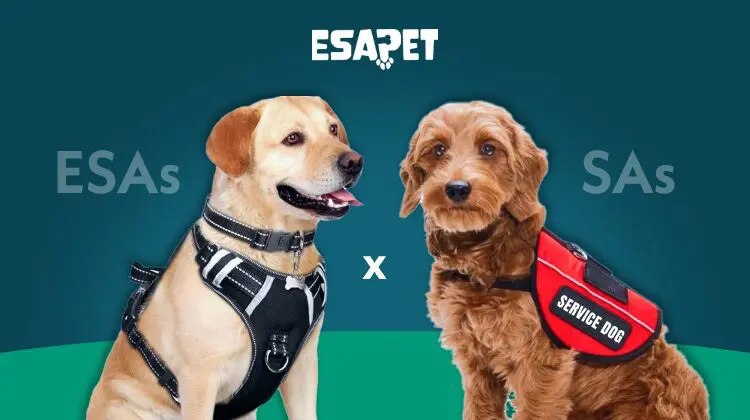
Emotional support animals (ESAs) provide therapeutic support through companionship and affection, while service animals/service dogs are specifically trained to perform tasks for individuals with disabilities.
A service animal under the Americans with Disabilities Act (ADA) is a dog of any breed or size that is trained to perform a task directly related to a person’s disability. Examples include retrieving objects, reminding a person to take medication, alerting a person before a panic attack, or helping a person remain safe during a seizure.
An emotional support animal provides comfort, companionship, affection, or therapeutic emotional support, but it is not required to be trained to perform a specific task. The Department of Justice explains that emotional support or comfort alone is not a task under the ADA.
The difference affects public access rights. Service animals are generally allowed in businesses, nonprofits open to the public, and state or local government facilities where the public may go. Emotional support animals do not have the same ADA public access rights, even though they may be protected in housing under the Fair Housing Act.
When Can a Landlord Legally Reject an ESA?
A landlord can legally reject an emotional support animal only for specific, evidence-based reasons. The decision should focus on the tenant’s disability-related need, the type of animal, the specific animal’s behavior, the rental property, and whether the accommodation is reasonable.
1. Tenant does not request a reasonable accommodation
A landlord is not required to grant an accommodation that has not been requested. The request does not have to use legal words like “reasonable accommodation” or “assistance animal,” and it may be oral or written, but the tenant must communicate that they are asking to get or keep an animal in connection with a physical or mental impairment or disability.
A written request is strongly recommended because it reduces confusion and creates a record. The request may be made before or after the tenant gets the animal, although waiting until after a lease violation or eviction notice can create avoidable disputes.
2. Tenant does not provide reliable documentation when needed
If the tenant’s disability and disability-related need are not obvious or already known, the landlord may ask for information that reasonably supports both. The landlord may not demand the tenant’s diagnosis, medical records, or unnecessary details about the severity of the disability.
A landlord should give the tenant a reasonable opportunity to provide missing documentation before denying the request. In many ESA cases, especially when the disability is non-observable, a lack of reliable documentation can justify denial.
3. The ESA letter is not reliable
A reliable ESA letter should come from a healthcare professional who can provide disability-related information based on professional knowledge of the tenant. HUD identifies physicians, psychiatrists, psychologists, physician assistants, nurse practitioners, nurses, and other health care professionals as possible sources of this information.
Online letters are not automatically invalid. A legitimate licensed provider may treat a tenant remotely. The issue is with internet certificates, registrations, licenses, or ID cards sold after a short questionnaire or fee; those documents are not, by themselves, reliable proof of a non-observable disability or disability-related need.
A landlord also does not have to accept forged, altered, or unsupported documentation. Tenants should avoid any service that promises instant “certification,” because there is no official federal ESA registry, certificate, or required ESA ID card.

4. Direct threat or risk of substantial damage
Landlords can legally deny an emotional support animal request if the animal poses a direct threat to the health or safety of others, but they must provide actual proof of this threat. The decision must be based on actual evidence about the animal, not fear, assumptions, breed stereotypes, or complaints that are not tied to a real risk.
The landlord should also consider whether the risk can be reduced or eliminated through reasonable steps. For example, a documented control plan, secure containment, leash use in common areas, or other practical measures may address some concerns. A denial is stronger when supported by records of aggression, serious property damage, repeated failure to control the animal, or other specific evidence.
5. The tenant cannot justify the need
HUD’s guidance treats dogs, cats, small birds, rabbits, hamsters, gerbils, other rodents, fish, turtles, and other small domesticated animals traditionally kept in the home as animals commonly kept in households. If the tenant has shown a disability-related need for one of these animals, the accommodation should generally be granted unless another lawful exception applies.
Different rules apply to unusual animals, such as barnyard animals, monkeys, kangaroos, or other non-domesticated animals. For example, a landlord may deny an emotional support animal if the request for accommodation is unreasonable, such as asking to keep a large animal (like a horse) in a small apartment. In those cases, the tenant has a substantial burden to show a disability-related therapeutic need for that specific animal or type of animal.
6. The request would impose an undue burden or fundamentally alter the housing
A reasonable accommodation does not have to be granted if it would impose an undue financial and administrative burden or fundamentally alter the nature of the housing provider’s operations. If a landlord denies a request on that basis, HUD’s guidance says the landlord should engage in an interactive process to discuss whether an alternative accommodation could meet the tenant’s disability-related needs.
This exception is fact-specific. A landlord should not rely on vague concerns about cost, inconvenience, other tenants, or insurance unless the concern is concrete, documented, and tied to the specific request.
7. The tenant asks for more than what law requires
A tenant may request permission to keep an ESA in the dwelling and to use areas needed for normal housing-related use and animal care. The Fair Housing Act can also cover public and common-use spaces connected to the housing.
That does not mean the tenant can demand every housing preference at no extra cost. A landlord may reject a request for a premium unit, extra bedroom, special roommate arrangement, or unrelated housing upgrade if the request is not necessary for the tenant’s disability-related use and enjoyment of the dwelling.
What Landlords Cannot Do
- A landlord cannot reject an ESA solely because the building has a no-pets policy. Enforcing a no-pets rule against a person who needs an assistance animal can deny that person equal use and enjoyment of the housing.
- Landlords cannot charge extra fees for emotional support animals, as they are considered medically necessary for the tenant’s well-being. However, the tenant can still be charged for actual damage caused by the animal if the landlord normally charges tenants for damage.
- A landlord cannot use blanket breed, size, or weight restrictions to deny an assistance animal. Breed or size may matter only if the specific animal creates an actual, evidence-based threat, damage risk, or unreasonable housing burden.
- A landlord cannot demand an official ESA registry, certification, ID card, or “certified” status as proof of housing rights. The ADA also makes clear that service animals are not required to be certified, professionally trained, or identified by a vest, and HUD’s housing guidance similarly rejects online registrations and certificates as reliable standalone proof for assistance animal requests.
- A landlord cannot ask for the tenant’s diagnosis or full medical records. The landlord may ask for information needed to evaluate the accommodation request when the disability or disability-related need is not obvious, but the request must stay limited to what is necessary.
What Tenants Should Provide
- Tenants should make the ESA request in writing, even though the request can be oral or written. A written request helps both sides track what was asked, when it was asked, and what documentation was provided.
- A strong tenant’s request should include that the tenant is requesting reasonable accommodation, that the request relates to a disability, and that the animal provides assistance or therapeutic emotional support connected to that disability. If the disability or need is not obvious, the tenant should include reliable documentation from a health care professional.
- The tenant does not have to disclose a full diagnosis. The documentation should support the disability-related need for the assistance animal without giving the landlord unnecessary private medical information.
What Landlords Should Do Before Denying a Request
Landlords should handle ESA requests through an individualized process. A careful approach includes:
- Confirming the request.
- Asking only for information that is actually needed.
- Giving the tenant a reasonable opportunity to provide missing documentation.
- Evaluating the specific animal.
- Considering alternatives if there is a concern and responding promptly.
A denial should explain the specific reason. Strong reasons include lack of reliable documentation after a reasonable opportunity to provide it, no disability-related need shown, a specific direct threat, likely substantial property damage, an unreasonable animal for the housing, or an undue financial and administrative burden.
Weak reasons include “we do not allow pets,” “that breed is banned,” “the animal is over our pet weight limit,” “other tenants may complain,” “the tenant did not buy an ESA certificate,” or “we charge pet rent to everyone.”
What Tenants Can Do If a Landlord Illegally Denies an ESA
A tenant can first respond in writing, clarify that the request is for a reasonable accommodation under the Fair Housing Act, provide missing reliable documentation if needed, and ask the landlord to identify the specific reason for denial.
If the landlord still refuses without a lawful reason, the tenant may file a housing discrimination complaint with HUD’s Office of Fair Housing and Equal Opportunity. HUD states that Fair Housing Act allegations must be filed within one year of the last date of the alleged discrimination, and recommends filing as soon as possible.
A tenant may also file a private civil lawsuit under the Fair Housing Act. HUD states that a private lawsuit generally must be filed within two years of the most recent discriminatory action, with time during HUD processing excluded from that two-year period.
Do FHA ESA Rules Apply to Every Landlord?
The Fair Housing Act covers most, but not every housing situation. HUD identifies limited exemptions, including some owner-occupied buildings with no more than four units, some single-family housing rented or sold without a broker, and housing operated by certain organizations or private clubs that limit occupancy to members.
Even when a federal exemption may apply, landlords and tenants should be careful. State or local fair housing laws may provide broader disability rights, and discriminatory advertising can create separate legal issues. A small private landlord should not assume an exemption applies without checking the exact facts and applicable state or local law.
Can a Landlord Deny an ESA Because of Other Tenants?
Not simply because other tenants dislike animals, are afraid of a breed, or object to emotional support animals. A landlord needs an individualized, evidence-based reason to deny the request.
Serious issues involving other tenants can matter if they create a real health or safety conflict. For example, a severe allergy or documented safety risk may require the landlord to evaluate competing needs and consider practical solutions before denying either tenant housing access. The correct approach is not a blanket denial, but a reasonable accommodation analysis based on the actual facts.
Can a Landlord Limit the Number of Emotional Support Animals?
Yes, in some cases. HUD recognizes that most reasonable accommodation requests involve one animal, but some requests involve more than one animal, including situations where one person needs more than one assistance animal or two residents each need a separate assistance animal.
Landlords should not automatically reject multiple ESAs just because there is more than one animal. They may ask for reliable support showing the disability-related need for each animal when that need is not obvious.
On the other hand, a landlord may deny or limit multiple emotional support animals if the number of animals would be unreasonable for the unit, violate applicable health or safety rules, create a direct threat, cause substantial damage, or impose an undue burden. For example, two documented cats in a suitable apartment is a very different request from keeping a large number of animals in a studio unit.
Can a Landlord Require Vaccination, Licensing, or Animal Control Compliance?
Yes, generally, if the requirement applies to animals under state or local law and is not being used as a pretext to deny the accommodation. The ADA allows state and local governments to require service dogs to be licensed and vaccinated when those requirements apply to all dogs, while also making clear that governments cannot require service-dog certification or registration.
For housing, a tenant should expect to comply with neutral animal-control rules such as vaccination, leash, sanitation, and waste-removal requirements. A landlord may also enforce reasonable conduct rules that keep the animal under control and protect the property, as long as those rules do not function as unlawful pet restrictions.
How a Valid ESA Letter Supports Your Housing Request
For tenants, the safest choice is to make the ESA request easy for the landlord to review: put it in writing, explain that it is a reasonable accommodation request, and include documentation that connects the emotional support animal to a disability-related need. The request does not need to reveal a diagnosis or private medical history, but it should give the housing provider enough reliable information to make a fair decision.
That is where a valid ESA letter matters. An ESA letter obtained through ESA Pet can help support the request, as it is issued by licensed healthcare professionals after a legitimate evaluation. You will receive a valid letter that clearly explains the need for an emotional support animal in housing. For landlords, that kind of documentation helps separate a valid accommodation request from an ordinary pet request and gives both sides a clearer path to resolving the issue without unnecessary conflict.

Get an ESA Letter from a Licensed Therapist
.png "Can a Landlord Reject an Emotional Support Animal? 4")
Sources
U.S. Department of Housing and Urban Development. (2020, January 28). Assessing a person’s request to have an animal as a reasonable accommodation under the Fair Housing Act (FHEO Notice No. 2020-01). https://www.hud.gov/sites/dfiles/PA/documents/HUDAsstAnimalNC1-28-2020.pdf
U.S. Department of Housing and Urban Development. (2020, January 24). Fact sheet on HUD’s assistance animals notice. https://www.hud.gov/sites/dfiles/PA/documents/AsstAnimalsGuidFS1-24-20.pdf
U.S. Department of Housing and Urban Development. (n.d.). Learn about FHEO’s process to report and investigate housing discrimination. https://www.hud.gov/stat/fheo/intake-investigation
U.S. Department of Housing and Urban Development. (n.d.). Fair housing: Equal opportunity for all. https://www.hud.gov/sites/documents/fheo_booklet_eng.pdf
U.S. Department of Justice, Civil Rights Division. (n.d.). Service animals. ADA.gov. https://www.ada.gov/topics/service-animals/
U.S. Department of Justice, Civil Rights Division. (n.d.). Frequently asked questions about service animals and the ADA. ADA.gov. https://www.ada.gov/resources/service-animals-faqs/
U.S. Department of Housing and Urban Development, & U.S. Department of Justice. (2004, May 17). Joint statement of the Department of Housing and Urban Development and the Department of Justice: Reasonable accommodations under the Fair Housing Act. https://www.justice.gov/sites/default/files/crt/legacy/2010/12/14/joint_statement_ra.pdf
Electronic Code of Federal Regulations. (n.d.). 24 CFR Part 103, Subpart B—Complaints. https://www.ecfr.gov/current/title-24/subtitle-B/chapter-I/part-103/subpart-B