

ADA Emotional Support Animal: Rights and Regulations

Joanna Martin, MSW, LCSW, is a licensed clinical social worker in Pennsylvania and Virginia with 23 years of experience specializing in anxiety and depression. She holds a Master’s in Social Work from the University of Pittsburgh and a Master’s in Community Counseling, along with a Bachelor’s in Psychology from Indiana University of Pennsylvania. Joanna is passionate about helping clients reach their full potential and enjoys supporting individuals who live with companion animals. Outside of work, she loves spending time at the beach with her husband, son, and their pets—a Black Lab named Abby and a hamster named Ham-Ham.
June 10, 2026
by Isys Bastos


Joanna Martin, MSW, LCSW, is a licensed clinical social worker in Pennsylvania and Virginia with 23 years of experience specializing in anxiety and depression. She holds a Master’s in Social Work from the University of Pittsburgh and a Master’s in Community Counseling, along with a Bachelor’s in Psychology from Indiana University of Pennsylvania. Joanna is passionate about helping clients reach their full potential and enjoys supporting individuals who live with companion animals. Outside of work, she loves spending time at the beach with her husband, son, and their pets—a Black Lab named Abby and a hamster named Ham-Ham.
June 10, 2026
by Isys Bastos
Many emotional support animal owners wonder whether the Americans with Disabilities Act, or ADA, gives their ESAs the same rights as service animals. The answer is usually no.
The ADA protects people with disabilities who use trained service animals. It does not give emotional support animals automatic public access rights. This means an ESA letter does not allow an emotional support animal to enter restaurants, stores, hotels, theaters, schools, hospitals, or other no-pets public places under federal ADA rules.
However, the answer can become more nuanced in two situations: psychiatric service dogs and workplace accommodation requests. A dog trained to perform specific psychiatric disability-related tasks may qualify as a service animal under the ADA. Separately, an employee may be able to request an emotional support animal as a workplace accommodation under ADA Title I, depending on the facts of the situation.
This guide explains how the ADA applies to emotional support animals, how ESAs differ from service animals and psychiatric service dogs, when workplace accommodations may apply, and how ADA rules differ from FHA housing protections.
Does the ADA Cover Emotional Support Animals?
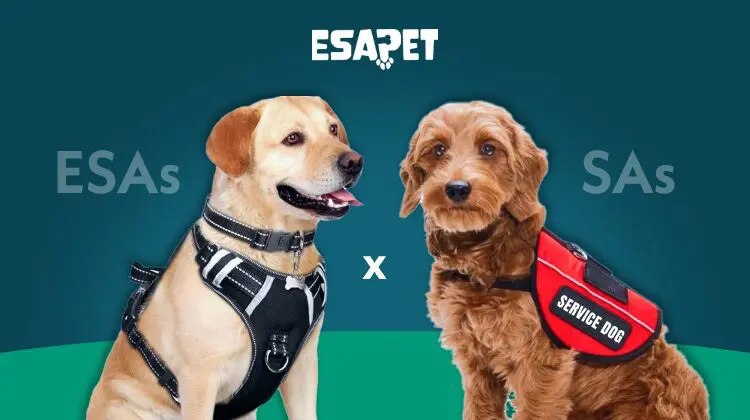
No. The Americans with Disabilities Act does not give emotional support animals the same public access rights as service animals. Under the ADA, a service animal is a dog that has been individually trained to do work or perform tasks directly related to a person’s disability. Emotional support animals provide comfort through their presence, but they are not trained to perform a specific disability-related task.
This is the central ADA rule for ESA owners: the ADA covers service animals, not emotional support animals. That means an ESA does not have an automatic federal right to enter restaurants, stores, hotels, hospitals, schools, government offices, or other public places where pets are not normally allowed.
However, some animals that support people with psychiatric disabilities may qualify under the ADA if they are trained to perform specific tasks. For example, a psychiatric service dog may be trained to interrupt a panic attack, remind a handler to take medication, wake a person from a nightmare, or guide a disoriented handler to safety. In those cases, the animal is not just providing emotional comfort. It is performing trained disability-related work.
In simple terms: emotional support alone is not enough for ADA public access. The animal must be trained to perform a specific task related to the person’s disability.
ADA Rules for Emotional Support Animals vs. Service Animals
The ADA creates public access protections for service animals, not emotional support animals. This distinction matters because many ESA owners assume that an ESA letter gives their animal the same access rights as a trained service dog. Under federal ADA rules, it does not.
A service animal must be individually trained to perform a specific task or job for a person with a disability. The task must be directly related to the person’s disability. For example, a service dog may guide a person who is blind, alert a person who is deaf, pull a wheelchair, retrieve dropped items, detect the onset of a seizure, or perform trained psychiatric tasks for a person with PTSD, panic disorder, or another qualifying disability.
An emotional support animal is different. An ESA may help reduce symptoms of anxiety, depression, PTSD, or another mental or emotional condition, but emotional comfort alone is not considered a trained task under the ADA. Because of that, an ESA is not automatically allowed in public places that prohibit pets.
The key question is not whether the animal helps the person feel better. The key ADA question is whether the animal has been trained to take a specific action that assists with the person’s disability.
What Is an Emotional Support Animal?
An emotional support animal is an animal that provides comfort, companionship, and emotional support to a person with a mental or emotional disability. ESAs commonly support people with conditions such as anxiety, depression, PTSD, panic disorder, or chronic stress-related symptoms.
Unlike a service animal, an ESA does not need to be trained to perform a specific disability-related task. Its support comes from its presence and the emotional relief it provides. That is why ESAs may qualify for certain housing accommodations under the Fair Housing Act, but they do not receive public access rights under the ADA.
ESA vs. Psychiatric Service Dog Under the ADA
A psychiatric service dog, or PSD, is different from an emotional support animal. A PSD is a dog that has been individually trained to perform specific tasks for a person with a psychiatric disability. Because of that training, a qualifying PSD may be considered a service animal under the ADA.
Examples of psychiatric service dog tasks may include interrupting self-harming behavior, waking a handler from night terrors, reminding a person to take prescribed medication, creating physical space during a panic episode, or guiding a disoriented handler to a safe location.
An emotional support animal may help with similar symptoms, but if the animal only provides comfort by being present, it is not considered a service animal under the ADA. The difference is task training: a PSD performs trained work, and an ESA provides emotional support.
Emotional Support Animal at Work: ADA Title I Workplace Accommodation
The ADA rules for the workplace are different from the ADA rules for public access. In public places, emotional support animals are not treated as service animals under the ADA. At work, however, an employee may be able to request an emotional support animal as a reasonable accommodation under ADA Title I.
ADA Title I applies to employment. It requires covered employers to provide reasonable accommodations to qualified employees or applicants with disabilities, unless the accommodation would create an undue hardship for the employer. This does not mean every employee has an automatic right to bring an ESA to work. It means the request may need to be evaluated through the reasonable accommodation process.
Can You Bring an Emotional Support Animal to Work?
Possibly, but not automatically. An employee who wants to bring an emotional support animal to work usually needs to request a reasonable accommodation from their employer. The employee may need to explain that they have a disability and that the animal is connected to their ability to perform essential job functions or access the workplace.
The employer may consider the specific facts of the request, including the employee’s disability-related need, the work environment, safety concerns, disruption to business operations, allergies or phobias of other employees, and whether another accommodation would be effective.
Workplace ESA accommodations differ from housing rights in one key way: employers evaluate accommodation requests case by case. An ESA letter may support the request, but it does not guarantee approval.
ESA vs. PSD at Work
A trained psychiatric service dog may have stronger legal standing than an emotional support animal because the dog performs specific disability-related tasks. However, even in the workplace, the employer may still need to evaluate the request through the reasonable accommodation process.
An ESA provides comfort through its presence. A PSD performs trained work. That distinction matters under the ADA because task training is the core difference between a service animal and an emotional support animal.
What Documentation Can an Employer Request?
If the disability or need for accommodation is not obvious, an employer may request reasonable documentation to support the accommodation request. This documentation generally should show that the employee has a disability and needs the requested accommodation because of that disability.
An ESA letter may help support a workplace accommodation request, but it does not automatically give an employee the right to bring an animal to work. The employer may still assess whether the accommodation is reasonable and whether it would create an undue hardship.
Because workplace accommodation rules can vary by situation and state law, employees and employers should consider getting legal guidance before making or denying an ESA-at-work request.
Public Access Rights: Where ESAs Are and Are Not Allowed Under the ADA
Under the ADA, public access rights apply to service animals, not emotional support animals. A trained service dog must generally be allowed to accompany a person with a disability in areas where members of the public are allowed to go. This can include restaurants, hotels, retail stores, government buildings, hospitals, schools, taxis, and other public accommodations.
Emotional support animals do not receive the same ADA public access rights. If a business has a no-pets policy, the business usually does not have to allow an ESA inside. An ESA letter does not turn an emotional support animal into an ADA service animal, and it does not create a federal public access right.
There are limited exceptions outside the ADA. A business may voluntarily choose to allow an ESA, and some state or local laws may provide additional protections. But under federal ADA public access rules, ESAs are not treated as service animals.
When Can a Service Animal Be Removed?
Even a trained service animal can be removed in limited situations. A business may ask a handler to remove a service animal if the dog is out of control and the handler does not take effective action to control it, or if the dog is not housebroken.
A business cannot remove a service animal simply because other people are afraid of dogs, have allergies, or do not want the animal present. The ADA focuses on whether the service animal is trained, under control, and accompanying a person with a disability.
The Only Two Questions Businesses Can Ask Under the ADA
When it is not obvious that a dog is a service animal, a business or public accommodation may ask only two questions under the ADA:
- Is the dog a service animal required because of a disability?
- What work or task has the dog been trained to perform?
Businesses cannot ask about the person’s diagnosis, require medical records, demand a special ID card, ask for a certificate, require an ESA letter, or ask the dog to demonstrate its task.
These two questions apply to service animals, not emotional support animals. If the animal is an ESA and has not been trained to perform a specific disability-related task, the ADA does not require the business to allow the animal into a no-pets area.
ADA vs. FHA vs. ACAA: Which Law Applies to ESAs?
Different federal laws apply to different situations. The ADA mainly controls public access rules for service animals. The Fair Housing Act, or FHA, is the main federal law that may protect emotional support animals in housing. The Air Carrier Access Act, or ACAA, controls disability-related animal rules for air travel.
This distinction is important because an ESA may have housing protections under the FHA but still have no public access rights under the ADA. In other words, a landlord may need to consider an ESA accommodation request, but a restaurant, hotel, store, or theater usually does not have to allow an ESA under federal ADA rules.
The ACAA has also changed. Emotional support animals no longer receive the same federal air travel protections they once had. Airlines may treat ESAs as pets, subject to the airline’s pet policies, fees, and restrictions. Psychiatric service dogs may still qualify for air travel protections if they meet the airline’s service animal requirements.
ADA vs. FHA: Key Differences for ESA Owners
The ADA and FHA are often confused because both relate to disability rights, but they apply in different situations. For ESA owners, the most important difference is that the ADA does not give emotional support animals public access rights, while the FHA may protect emotional support animals in housing.
Under the ADA, emotional support animals are not considered service animals because they are not trained to perform specific disability-related tasks. This means an ESA does not have an automatic right to enter restaurants, stores, hotels, theaters, hospitals, schools, or other public places where pets are not normally allowed.
Under the FHA, an emotional support animal may qualify as an assistance animal when the person has a disability-related need for the animal. In that situation, a housing provider may need to consider a reasonable accommodation request, even if the property has a no-pets policy.
| Comparison Point | ADA | FHA |
|---|---|---|
| Covers ESAs? | No, not for public access. | Yes, for qualifying housing needs. |
| Main scope | Public access and some employment issues. | Housing accommodations. |
| Applies to | Trained service animals. | Assistance animals, including ESAs. |
| Documentation | Businesses cannot require ESA letters, certificates, or registration. | Housing providers may request reliable documentation. |
| Result | ESA letters do not create public access rights. | ESAs may be allowed despite no-pets policies. |
The simple way to remember the difference is this: the ADA controls public access for service animals, while the FHA is the main federal law that may protect emotional support animals in housing.
ESA Housing Rights Under the FHA
Emotional support animals may be protected in housing under the Fair Housing Act when the person has a disability-related need for the animal. In this context, a disability generally means a physical or mental impairment that substantially limits one or more major life activities.
For ESA housing requests, the key issue is whether the animal helps with symptoms or limitations related to the person’s disability. If the disability or need for the animal is not obvious, a housing provider may request reliable documentation, such as an ESA letter from a licensed healthcare professional.
A reasonable accommodation may allow an ESA to live with the person even when the property has a no-pets policy, breed restriction, size limit, or pet fee. However, the housing provider can still evaluate whether the request is valid and whether the animal would create a direct threat, cause significant property damage, or impose an unreasonable burden.
The Fair Housing Act can apply to many types of housing, including apartments, rental homes, condos, HOAs, and some university or assisted housing. Some owner-occupied buildings, single-family homes rented without a broker, and certain private clubs or religious housing may be exempt. Because coverage depends on the specific housing situation, ESA owners should review FHA rules before submitting a request.
Emotional Support Animal vs. Service Dog: The ADA Difference
The ADA difference between an emotional support animal and a service dog comes down to training.
An emotional support animal helps a person by providing comfort, companionship, and emotional stability. The animal may ease symptoms of anxiety, depression, PTSD, or another mental or emotional disability. But if the animal is not trained to perform a specific disability-related task, it is not a service animal under the ADA.
A service dog is trained to take a specific action that helps a person with a disability. That task may be physical, sensory, psychiatric, neurological, or medical. The dog’s work must be directly related to the person’s disability.
A psychiatric service dog is a type of service dog. It may support a person with a psychiatric disability, but it must do more than provide comfort. It must be trained to perform a task, such as interrupting harmful behavior, responding to panic episodes, reminding the handler to take medication, or guiding the handler during disorientation.
For ADA purposes, emotional comfort alone is not enough. Task training is what separates a service dog from an ESA.
What Disabilities May Qualify for a Service Animal Under the ADA?
The ADA does not limit service animals to one type of disability. A service animal may assist a person with a physical, sensory, psychiatric, intellectual, neurological, or other disability.
Examples may include blindness, low vision, deafness, mobility limitations, seizure disorders, diabetes, PTSD, panic disorder, and other conditions that substantially limit one or more major life activities.
However, the diagnosis alone is not what makes a dog a service animal. Under the ADA, the dog must be trained to perform work or tasks directly related to the person’s disability. A dog that only provides comfort, emotional support, or companionship is not a service animal under the ADA, even if the person has a qualifying disability.
Do You Need an ESA Letter or a PSD Letter?
The type of documentation you may need depends on the role your animal plays.
If your animal provides emotional support but is not trained to perform disability-related tasks, it may be an emotional support animal. In that case, an ESA letter may help support a housing accommodation request under the Fair Housing Act. An ESA letter does not create ADA public access rights.
If your dog is trained to perform tasks related to a psychiatric disability, it may be a psychiatric service dog. A PSD letter may help document your need for a psychiatric service dog, but the ADA does not require service animals to be registered, certified, or professionally trained for public access.
The most important distinction is task training. If the animal provides comfort only, it is likely an ESA. If the dog is trained to perform specific disability-related tasks, it may qualify as a service animal under the ADA.

Check if You Qualify
.png "ADA Emotional Support Animal: Rights and Regulations 4")
FAQs About ADA Emotional Support Animal Rules
Does the ADA protect emotional support animals?
No. The ADA does not protect emotional support animals for public access. The ADA protects service animals that are individually trained to perform tasks directly related to a person’s disability. ESAs provide comfort, but comfort alone is not considered a trained ADA service animal task.
Can I bring an emotional support animal into a restaurant under the ADA?
Usually no. Restaurants and other public places generally do not have to allow emotional support animals under the ADA. They must allow qualifying service animals, but an ESA is not a service animal unless it has been trained to perform a specific disability-related task.
Can an emotional support animal go to work with me?
Possibly, but not automatically. In the workplace, an employee may request an ESA as a reasonable accommodation under ADA Title I. The employer may review the request, ask for reasonable documentation if the need is not obvious, and determine whether the accommodation is reasonable or would create an undue hardship.
Is a psychiatric service dog the same as an emotional support animal?
No. A psychiatric service dog is trained to perform specific tasks for a person with a psychiatric disability. An emotional support animal provides comfort through its presence. Under the ADA, task training is what separates a psychiatric service dog from an ESA.
Can a business ask for an ESA letter under the ADA?
A business does not have to accept an ESA letter as proof of ADA public access rights because ESAs are not service animals under the ADA. For service animals, businesses cannot require documentation, registration, certification, or medical records. They may only ask the two ADA-permitted questions when the service animal’s role is not obvious.
What are the two ADA questions a business can ask?
A business may ask: “Is the dog a service animal required because of a disability?” and “What work or task has the dog been trained to perform?” The business cannot ask about the person’s diagnosis, demand documentation, or require the dog to demonstrate its task.
Does the FHA protect emotional support animals?
Yes, the Fair Housing Act may protect emotional support animals in housing when the person has a disability-related need for the animal. This is different from the ADA. The FHA may apply to housing accommodations, while the ADA mainly applies to public access rules for service animals.
Do emotional support animals have airline rights under the ACAA?
Emotional support animals no longer have the same federal air travel protections they once had. Airlines may treat ESAs as pets and apply pet fees, size limits, carrier rules, or other restrictions. Psychiatric service dogs may still qualify for air travel protections if they meet the airline’s service animal requirements.
Are comfort animals covered by the ADA?
No. Comfort animals are generally not covered as service animals under the ADA if they only provide comfort by being present. The ADA requires a service animal to be trained to perform a specific disability-related task. A comfort animal may help emotionally, but comfort alone is not considered trained service animal work under the ADA.
Are therapy animals covered by the ADA?
No. Therapy animals are not the same as ADA service animals. A therapy animal may visit hospitals, schools, nursing homes, or other settings to provide comfort to many people, but it is not individually trained to perform disability-related tasks for one specific handler. Because of that, therapy animals do not receive ADA public access rights.
Final Thoughts: ADA Emotional Support Animal Rules
The ADA does not give emotional support animals the same public access rights as service animals. For ADA purposes, the key distinction is task training. A dog that is individually trained to perform disability-related work may qualify as a service animal. An animal that provides comfort through its presence is generally considered an emotional support animal, not an ADA service animal.
That does not mean ESAs have no legal protections. Emotional support animals may still qualify for housing accommodations under the Fair Housing Act, and some workplace ESA requests may be considered under ADA Title I as reasonable accommodation requests. But those rights are different from ADA public access rights.
For ESA owners, the most important takeaway is this: an ESA letter may help with housing, but it does not give your animal automatic access to restaurants, stores, hotels, airplanes, or other public places under the ADA. If your dog is trained to perform specific psychiatric or disability-related tasks, it may be a psychiatric service dog rather than an ESA.
Understanding the difference between an ESA, a psychiatric service dog, and a service animal can help you know which laws apply and what documentation may actually be useful.

Update Notes
Feb. 18, 2026: This article was medically reviewed by Joanna Martin
Jun. 10, 2026: This article was updated to include clearer public access, workplace accommodation, and FHA housing-rights guidance.