


Which Airlines Allow Emotional Support Animals? Can Emotional Support Dogs Fly?
 Written by
Flying with emotional support animals (ESAs) changed dramatically in 2021. Travelers seeking to fly with ESAs now face strict regulations, even if they have an ESA letter.
The Department of Transportation (DOT) revised its rules, eliminating previous protections for ESAs on aircraft. This means the ability for an emotional support animal to fly free in the cabin as an assistance animal is no longer required for airlines, and ESAs are treated differently from service animals that qualify under federal air rules.
The Short Answer: Can You Fly With an Emotional Support Animal?
You cannot fly with an emotional support animal under the same rules as a service animal or other service-animal teams that meet DOT standards. For most travelers with emotional support animals, airlines now apply standard pet policies, even if the emotional support animal was previously accepted in-cabin.
Due to Department of Transportation (DOT) rule changes, airlines are no longer required to treat ESAs as service-animal companions. This mandate shifts how airlines consider support animals during flights, including emotional support animals and other support animals. Most major US carriers now categorize ESAs as pets rather than assistance animals during domestic flights.
The Air Carrier Access Act (ACAA) no longer grants ESAs the same protections as service dogs or other trained service-animal teams, impacting recent changes for all flights. Under the Air Carrier Access Act, only service animals, including service dogs, are guaranteed cabin access without pet fees.
The Law: Air Carrier Access Act (ACAA) vs. Fair Housing Act

Understanding the distinction between housing and air travel regulations for assistance animals is crucial, especially for emotional support animals and other assistance pets. The same emotional support animal that may be approved for housing isn’t treated the same way for flights, and support animals in the air travel context follow different standards.
Fair Housing Act (FHA) — housing rules
The Fair Housing Act (FHA) includes allowances for ESAs as a type of assistance animal within housing contexts. This legal framework prohibits discrimination in the sale or rental of housing based on a person’s disability. A request for an assistance animal in housing is a reasonable accommodation under the FHA.
Housing providers cannot charge pet deposits or pet fees for these assistance animals, including ESAs and emotional support animals. A licensed mental health professional or mental health professional can issue documentation, and a mental health professional stating the need for an emotional support animal is typically sufficient for housing requests.
The FHA does not require an assistance animal to be individually trained or certified, and it is not limited to dogs. Housing providers may request reliable documentation of the disability if it is not obvious. They can deny requests imposing undue financial burdens or fundamental alterations to services.
Air Carrier Access Act (ACAA) — air travel rules
Conversely, the ACAA aligns with the Americans with Disabilities Act (ADA) definitions for air travel. Under the ADA, a service animal is a dog individually trained to perform tasks for a person with a disability. ESAs do not qualify as service animals under the ADA Titles II and III.
This distinction means airlines no longer have to treat ESAs as service-animal accommodations, even when those animals are well-behaved. In air travel, service animals and service dogs must meet task-training standards, while emotional support animals and other support animals do not.
Which Airlines Allow Emotional Support Animals?

To answer which airlines allow emotional support animals today: ESAs aren’t permitted in the cabin anymore unless they’re small enough to travel in an under-seat carrier, in which case they’re treated as regular pets. In practice, ESAs that fit in a carrier fly as pets, not as service animals or service dogs. For larger emotional support animals, the same applies—they travel under pet rules, not service animal rules. If you’re living with a dog under ESA status, expect to follow the same pet requirements.
Which airlines are no longer allowing ESA? (Answer: Nearly all major US carriers).
- Delta Airlines
- American Airlines
- United Airlines
- Southwest Airlines
- Alaska Airlines
- JetBlue
- Hawaiian Airlines
These carriers now exclude ESAs from service-animal protections and from the protections given to service dogs and psychiatric service dogs.
This means most airlines require ESAs to travel as standard pets, subject to pet fees and specific travel regulations. Nearly all major US carriers are no longer allowing ESA pets to fly freely in the cabin.
Delta Airlines no longer allows ESA animals to fly as service animals. Instead, your ESA travels as a pet or a fully trained service dog. International flights may have different rules, but U.S.-based travel and most international carriers have tightened regulations. You must verify specific policies with each airline ahead of your trip.
The common rule is that only service animals and service dogs are granted cabin access without a pet fee. ESAs, emotional support animals, and emotional support dogs do not qualify for air-travel access under service-animal rules, even with a licensed mental health professional or mental health professional stating the need, since a mental health professional stating support is not enough for flights.
Airlines that Still Allow Emotional Support Animals
Although most airlines follow standard pet policies, a few air carriers in Central and South America still accommodate emotional support animals for in-cabin travel on select routes. Always confirm directly with the airline before booking, because requirements can be route-specific.
LATAM Airlines

LATAM allows emotional support animals in the cabin at no extra charge only on certain routes, including flights to or from Argentina, Mexico, and Colombia, plus domestic flights within Colombia. They require advance notice and approval, and they limit eligible animals mainly to dogs and cats that meet weight/behavior rules. Some higher-risk breeds aren’t allowed in the cabin, and the airline caps the number of approved support animals per flight.
Volaris

Volaris also permits emotional support animals on specific routes in Mexico and parts of Central/South America. Still, they require an ESA letter issued within the last year and signed by a licensed mental health professional. Volaris typically limits ESAs to dogs and cats under a set weight threshold. Depending on the flight, they may allow the animal on your lap with a leash/harness rather than requiring a carrier.
Get your Official ESA Letter Consultation from a licensed therapist.
Get ESA Letter Now
Aeromexico

Aeroméxico continues to accommodate emotional support animals on many of its routes, especially within Mexico and Latin America, but approval depends on documentation and size/behavior rules. ESAs are generally limited to smaller dogs or cats and must remain calm through boarding and the flight. Aeroméxico also notes that seating adjustments may be needed if another passenger has allergies or safety concerns.
Major Airlines that Will Accept Emotional Support Animals & Pets for a Fee
Even though they don’t grant ESAs service-animal status anymore, several big airlines still let you bring a dog or cat in the cabin as a pet if it fits airline size rules and you pay the pet fee. This applies whether your animal is an ESA or not. Examples include:
- Alaska Airlines
- Southwest Airlines
- United Airlines
- American Airlines
- Delta Airlines
- Hawaiian Airlines
The Exception: Psychiatric Service Dogs (PSD) vs. ESAs
Psychiatric service dogs (PSDs) are distinct from ESAs. This difference holds significant weight for air travel, because PSDs are treated differently from ESAs without task training.
A Psychiatric Service Dog is a service animal under Title II and III of the ADA. These dogs are individually trained to do work or perform specific tasks for a person with a disability. The work or tasks must directly relate to the individual’s psychiatric disability. Examples include sensing an anxiety attack and taking action to mitigate it, or providing deep pressure stimulation for post-traumatic stress disorder (PTSD).
ESAs provide companionship, relieve loneliness, and help with general depression symptoms or anxiety. These animals do not have special training to perform specific tasks. Assistance Dogs International clarifies that an emotional support dog provides comfort by its presence. It does not perform tasks to mitigate a disability, so ESAs are not service animals, and emotional support dogs are not service dogs.
PSDs are allowed to fly in the cabin free of charge when traveling with their disabled handler. This remains an option for individuals with an emotional or mental disability requiring a trained service dog. You must adhere to specific airline requirements for flying with PSDs and other trained service dogs recognized as service animals. Usually, a valid PSD Letter issued within a year is a basic requirement.
Get your Official PSD Letter Consultation from a licensed therapist.
Get PSD Letter Now
How to Distinguish a PSD from an ESA?
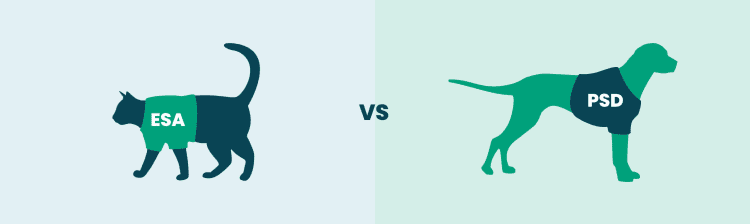
Distinguishing a Psychiatric Service Dog from an ESA relies on specific criteria:
- Task Training: The dog must be individually trained to perform specific tasks directly related to your disability. This training goes beyond providing comfort or companionship. That’s why trained service dogs qualify for flight access, while ESAs do not.
- DOT Form: You must complete a Department of Transportation (DOT) Service Animal Air Transportation Form. This form confirms the dog’s training and health, and that it will behave during the flight.
- Public Access: A trained service animal has public access rights when working with its handler. An ESA does not possess these same public access rights, and ESAs are treated as pets under federal air rules.
Flying with an ESA: Costs and Requirements
When you travel with an emotional support animal, they now fly as pets. Most airlines no longer accept emotional support animals in the cabin as service animals; they are treated like pets.
Because airlines don’t accept emotional support animals as assistance animals for flights, many travelers find that an emotional support animal must fly under standard pet rules. The cost to fly with an emotional support animal varies by airline, generally ranging from $100 to $125 each way for in-cabin travel. Many airlines also set limits on the number of pets allowed per flight, so emotional support animals travel under standard pet rules.
Here’s what that looks like in practice:
- Carrier rules: Your pet carrier must fit under the seat in front of you, and emotional support animals must remain in the carrier during boarding and the flight.
- Size and weight limits: Airlines enforce weight limits for in-cabin pets, so smaller emotional support animals can fly in the cabin as pets, while a larger emotional support animal travels in cargo under pet rules.
- Cargo travel still counts as pet travel: Even if an airline will accept emotional support animals in cargo, an emotional support animal is still treated as a pet, not as a service animal.
In short, emotional support animals are welcome only under pet policies. That means emotional support animals need carriers, and emotional support animals may be limited per flight. Airlines group emotional support animals with support animals for seating limits, and emotional support animals with support animals for cargo safety rules.
Suppose you’re traveling with more than one pet. One pet cat and an emotional support cat. Each counts toward the cabin cap, and emotional support animals must follow the same size and health rules.
Bottom line: emotional support animals still need to follow pet rules, and they should be booked early. Emotional support animals may travel in the cabin only if they fit in a carrier; if not, they may be routed to the cargo hold.
Flying With an Emotional Support Animal (As a Pet): 4 Key Steps
Flying with an Emotional Support Animal as a pet involves four main steps:
- Booking in Advance: Book your emotional support animal’s travel in advance. Airlines limit the number of pets allowed in the cabin on each flight, and an emotional support animal counts toward those limits. If you hope an airline might accept emotional support animals on a specific route, booking early helps.
- The Pet Carrier: Your pet carrier must meet airline size requirements to fit under the seat. The carrier needs ventilation and must allow your emotional support animal to stand up and turn around comfortably. Emotional support animals that don’t fit in a carrier cannot fly in the cabin and must follow cargo rules.
- Health Documents: Obtain health certificates and vaccination records from your veterinarian. A licensed mental health professional may document your need for an emotional support animal for housing, and another licensed mental health professional can confirm your condition, but airlines focus on pet health documents instead of service-animal paperwork.
- Check-in Process: Airline staff will verify your emotional support animal’s documentation and carrier compliance. Even with a letter, airlines will not accept emotional support animals as service animals.
Learn more: Read our dedicated article about airline requirements and the processes to fly with an emotional support dog (as a pet).
Can Emotional Support Dogs Fly Internationally?
Emotional support dogs can fly internationally in some cases — but it depends on two things: the airline’s ESA policy for that specific route and the pet import rules of every country you’re entering or transiting.
For trips that include U.S. airlines (or flights to/from the U.S.), emotional support dogs are almost always treated as pets, not as service animals, meaning you’ll need to follow pet fees and carrier rules. Outside the U.S., a few carriers — especially in Central and South America — still allow emotional support dogs in the cabin on select routes if you meet their documentation and size requirements.
Even when an airline allows ESAs internationally, you still have to comply with country-level requirements, like vaccination records, health certificates, breed restrictions, and possible quarantine rules. In other words, airline approval isn’t the final step — the destination country can still deny entry if paperwork or health rules aren’t met.
Frequently Asked Questions on Flying with ESAs
No major US airlines accept emotional support animals for free cabin travel as service animals. Your emotional support dog must fly as a pet, and emotional support animals are treated like other pets.
Some international airlines may accept emotional support animals on limited routes, but you must contact them ahead of time if you want them to accept emotional support animals.
No US airlines officially accept emotional support animals for free cabin access as service animals. Emotional support animals fly as pets, and an emotional support dog or cat follows pet travel rules unless it qualifies as a service dog under service-animal policies.
Airlines do not accept emotional support animals as cabin-free assistance pets; they travel like other support pets.
Yes. Airlines are no longer required to accept emotional support animals based on an ESA letter or to accept emotional support animals as service animals.
Airlines require documentation for a service dog and for psychiatric service dog teams, including psychiatric service task-training forms. ESA letters from mental health providers don’t change flight rules for emotional support animals.
Know Your Rights Before You Fly
The rules for flying with emotional support animals have changed significantly. Airlines do not accept emotional support animals as service animals under federal air rules, so emotional support animals will likely travel as pets. You must plan for pet fees and meet carrier requirements, because emotional support animals no longer have cabin rights.
Fair Housing Act protections for assistance animals in housing do not extend to flights. If you have an emotional or mental disability and need psychiatric service dogs, they are treated as service animals and can fly with you as a service dog for free.
Only trained service animals are granted cabin access without pet fees, and only trained service animals include psychiatric service dogs performing psychiatric service tasks. A psychiatric service dog is different from an emotional support dog, and psychiatric service work is what separates psychiatric service dogs from emotional support animals.


Dogs, Emotional Support Animal, Food, Housing, Travel
How to Make Your Dog a Service Dog? Serv...

Jonalyn Dionio
Dec 12 2025

Dogs, Emotional Support Animal, Travel
Spirit Airlines Pet Policy – Your ...

Brenda Mejia
May 8 2024