

Crate Training a Puppy: How to Create a Safe and Comfortable Space
 Written by
Bringing a new puppy into your home is an exciting time, yet it comes with questions about setting the right routines. Many families wonder how to crate train a puppy, aiming for a smooth transition and a secure environment for their new furry family member. Crate training, when done correctly, offers a true sanctuary for a new puppy.
This guide explains ethical, effective ways to begin crate training a puppy, ensuring it becomes a safe haven rather than a place of stress. We discuss everything from selecting the right crate to understanding the best training schedules. Our goal is to help you prevent misuse of crates and promote a method that offers security for your whole family and your pup.
Why Crate Train a Puppy?
Crate training a puppy utilizes a dog’s natural instinct to seek a safe, quiet den.source The crate acts as an indoor kennel, providing a secure, den-like atmosphere for your dog.source This method is a veterinarian-recommended approach for housebreaking puppies.
- Crates serve as a tool to prevent chewing on household items, protecting your belongings from a destructive behavior.source
- A crate provides a safe way to transport a dog in a vehicle, making travel less stressful for everyone involved.source
- Crate training aids in house-training by leveraging a dog’s instinct to avoid soiling its sleeping area.source
- This process helps dogs feel secure and reduces anxiety when used correctly.
- Crates minimize stress during the transition to a new home, giving your dog a familiar, safe space.
- Crate training creates a positive association with the crate, which can also help with separation anxiety.
How Crate Training Works
The “den concept” explains how dogs naturally seek dens for sleeping quarters. This single entrance offers a sense of security for them, mirroring a natural den.source This instinct forms the foundation of successful dog training.
Dogs instinctively avoid soiling their sleeping dens. This natural inclination aids in house-training, helping your puppy learn appropriate elimination habits. The long-term goal for your dog involves regarding the crate as its personal bedroom, where it voluntarily retreats for comfort and rest.source
How to Crate Train a Puppy
Learning how to train your dog involves a definitive, gradual procedure. Crate training should start as soon as your puppy comes home, ideally around 8 weeks of age.
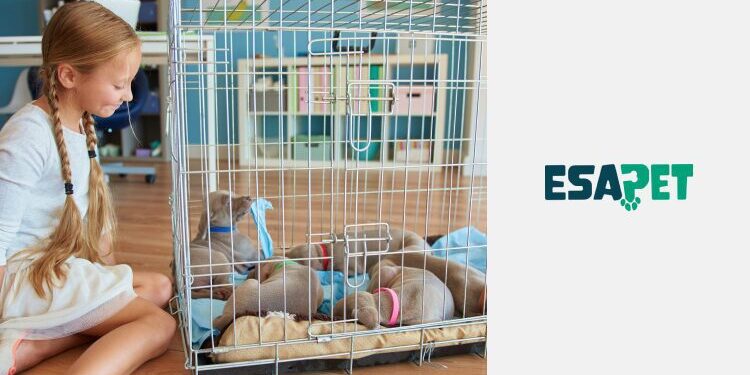
1. Preparation. Place the crate in a family-frequented area like the family room.source The crate should be placed in a location where the family spends time to help the puppy feel secure. Make it inviting by placing soft blankets or towels inside.source You can also place a toy or item with your scent inside to make it inviting.
Introduction. Keep the door open or removed initially, letting the dog explore the crate at its leisure.source Owners use treats to entice the dog into the crate until the dog enters willingly.source Toss a favorite toy into the crate to encourage entry if the dog is not interested in treats.source Establish a specific command like “kennel up” for entering the crate.
Feeding. Begin feeding regular meals inside the crate to create a positive association.source This helps condition the dog to view the crate as a positive space. To build positive associations with the crate, feed meals inside, toss treats, and play crate games.
Closing the Door. Once the dog in the crate eats meals without fear, practice closing the door for short periods while you sit quietly nearby for 5 to 10 minutes.source Departures should be matter-of-fact and devoid of prolonged emotion to help the dog feel secure.source
Increasing Duration. Gradually increase the time the dog stays in the crate to 30 minutes while you are out of sight.source Begin leaving the room during training, then gradually extend your absence. A consistent routine helps puppies understand expectations regarding crate time, meals, and potty breaks.
How to Choose a Crate
A crate must be large enough for the dog to stand up and turn around freely, then lie down comfortably.source If a crate is too large, a puppy uses one end as a bathroom and the other as a bed, hindering house training efforts.source You can block the back portion of a large crate with a divider to adjust its size for a growing puppy.source
| Crate Type | Features |
| Plastic Crates | Plastic crates offer more privacy and are lightweight, making them easy to move and clean. These are suitable for airline travel.source |
| Wire Crates (Metal) | Metal crates provide good ventilation and visibility for puppies, which can help with separation anxiety. These are often collapsible for storage.source |
| Soft-Sided Crates | Soft-sided crates are lightweight and comfortable, but they are not suitable for puppies that like to chew or scratch. |
How Long Does Crate Training Take?
Understanding how long a puppy can stay in a crate is crucial for its well-being and successful training. Puppies under six months of age should not remain in a crate for more than three or four hours at a time.source Young puppies cannot control their bladders or bowels for long durations. Puppies at 16 weeks of age should have no difficulty holding their bladder for 2 hours.
A puppy crate training schedule mandates frequent breaks. Dogs crated for excessive periods may develop depression or anxiety due to lack of exercise and interaction.source Establishing set times for crating within the daily routine assists in preparing the puppy for crate use. The goal is to leave the crate door open at night after about 6 months of no accidents.source
How to Manage Whining in the Crate Training Schedule
If a dog whines in the crate, it should be ignored unless it is likely a need to go eliminate.source Letting a whining dog out teaches them that making noise gets them released.source Scolding a whining puppy can be rewarding to them because it provides attention.source Whining during crate training can indicate that a dog needs to eliminate or is testing boundaries.
Signs of distress significantly increase when dogs are caged specifically for behavioral purposes.source Ignoring signs of distress from a puppy, like frantic scratching or excessive barking, can lead to serious anxiety and injury. You must differentiate between a puppy testing boundaries and a dog experiencing genuine distress. If the dog is truly distressed, assess its need to go outside or potential discomfort.
Crate Training Common Mistakes
- Punishment: Owners should never use a crate as a form of punishment.source This creates fear and aversion to the crate. Punishing after the fact teaches the dog to fear the owner’s anger rather than correcting the behavior.
- Forcing Entry: Forcing a puppy into a crate can cause trauma by associating it with unpleasant experiences.source They should enter voluntarily and gradually, using positive incentives to avoid overwhelming the puppy and causing anxiety.
- Misinterpreting Accidents: Accidents in the crate are typically not the puppy’s fault but a sign they need to go out more often.source Use enzymatic cleaners to clean up accidents and remove odors that attract the dog back to the same spot.
- Isolation: The crate should be placed in a central part of the home rather than an isolated area.source If used incorrectly or in isolation, a crate can make a dog feel trapped and frustrated.source
Crate Training FAQs
Yes, crate training can help with separation anxiety by creating a positive association with the crate. Crating a dog with separation anxiety may lead to self-injury, such as broken teeth or ripped nails, if done without professional guidance.source
You should place the dog’s crate in a family-frequented area like the family room during the day.source At night, the crate should be placed in a bedroom so the dog feels part of the family.
You should make the crate inviting by placing soft blankets or towels inside.source A favorite toy or an item with your scent makes the crate even more comfortable and secure.
Yes, initially leave the crate door open or removed to let the dog explore the crate at its leisure.source This helps create a positive association with the crate.
Place the crate in your bedroom at night or use a tether in the bedroom for nighttime supervision.source This allows your puppy to feel close to you while still maintaining its safe space.
No, soft-sided crates are not suitable for puppies that like to chew or scratch. These types of crates tear easily, presenting a potential escape route or ingestion hazard.
Yes, crate training is a veterinarian-recommended method for housebreaking puppies.source Dogs instinctively avoid eliminating in their sleeping areas, making crate training beneficial for house training.
Plastic crates are suitable for airline travel because they are lightweight and meet most airline requirements.source These types of crates offer more privacy for the dog during travel.
Yes, crate training can be successful for adult dogs and older dogs, though it may take more patience than with puppies. Older dogs often have established habits, so progress may be slower, but using positive reinforcement, consistency, and short training sessions can help them learn that the crate is a safe and comfortable space.
A crate can be placed in the laundry room if it is quiet, well-ventilated, and not exposed to loud noises from machines. However, dogs generally prefer being near their family, so a common living area is often a better choice during the day.
Yes, leaving the crate open when you are home allows your dog to enter and exit freely. This reinforces the crate as a voluntary, positive space rather than a place of confinement and encourages relaxation.
Placing food inside the crate during meals or training helps build positive associations. Water can be provided for short crate sessions, but for longer periods, ensure your dog has had access to water beforehand and regular breaks.
If your dog cries, wait for a brief pause in the noise before opening the crate. Letting them out while crying teaches them that vocalizing leads to release. Waiting for calm behavior helps reinforce good habits.
If the crying begins to repeat, evaluate whether your puppy’s needs are being met—such as potty breaks, exercise, and comfort. Stick to a consistent routine, avoid reinforcing crying, and offer reassurance without removing the puppy from the crate unless necessary.
You should take your dog to the vet if you see signs of extreme distress, self-injury, excessive drooling, or panic when crated. A veterinarian can rule out medical issues and may recommend a trainer or behavior specialist if needed.
Conclusion
A crate should always be viewed as a tool for safety, not a prison. When introduced for a few minutes at a time, with as much ventilation as possible, a crate can create an open, new environment that helps your dog feel comfortable and secure.
For a new dog, crate training is a great idea because it establishes a routine while offering a safe place to relax and decompress. Used correctly, a crate supports emotional well-being by giving dogs a calm retreat where they can self-soothe, settle, and feel protected during stressful moments. Crate training helps puppies learn to self-soothe and settle, especially during stressful situations.
Sources
Peer-Reviewed Journal Articles
Bleuer-Elsner, S., & Masson, S. (2024). The cage as an educational and therapeutic tool for dogs: Results of a dog’s owners questionnaire survey. Applied Animal Behaviour Science, 279, Article 106386. https://doi.org/10.1016/j.applanim.2024.106386
Web Resources
Animal Humane Society. (n.d.). Crate training your dog or puppy. Retrieved from https://www.animalhumanesociety.org/resource/crate-training-your-dog-or-puppy
PAWS. (n.d.). How to crate train your dog. Retrieved from https://www.paws.org/resources/how-to-crate-train-your-dog/
University of California, Davis, School of Veterinary Medicine. (n.d.). Crate training your puppy [PDF]. Retrieved from https://www.vetmed.ucdavis.edu/sites/g/files/dgvnsk491/files/inline-files/Crate_Training_Your_Puppy.pdf
Mills, B. G., DVM. (n.d.). Crate and house training [PDF]. Integrative Veterinary Care. Retrieved from https://www.integrativeveterinarycare.us/uploads/8/1/3/6/81365658/crate_and_house_training_.pdf