
Emotional Support Animal Laws 2026: FHA Requirements & ESA Rights by State

Joanna Martin, MSW, LCSW, is a licensed clinical social worker in Pennsylvania and Virginia with 23 years of experience specializing in anxiety and depression. She holds a Master’s in Social Work from the University of Pittsburgh and a Master’s in Community Counseling, along with a Bachelor’s in Psychology from Indiana University of Pennsylvania. Joanna is passionate about helping clients reach their full potential and enjoys supporting individuals who live with companion animals. Outside of work, she loves spending time at the beach with her husband, son, and their pets—a Black Lab named Abby and a hamster named Ham-Ham.
May 26, 2026


Joanna Martin, MSW, LCSW, is a licensed clinical social worker in Pennsylvania and Virginia with 23 years of experience specializing in anxiety and depression. She holds a Master’s in Social Work from the University of Pittsburgh and a Master’s in Community Counseling, along with a Bachelor’s in Psychology from Indiana University of Pennsylvania. Joanna is passionate about helping clients reach their full potential and enjoys supporting individuals who live with companion animals. Outside of work, she loves spending time at the beach with her husband, son, and their pets—a Black Lab named Abby and a hamster named Ham-Ham.
May 26, 2026
Emotional Support Animal (ESA) laws are shaped by an intersection of federal law and state and local laws, which vary widely in scope, terminology, documentation standards, and enforcement practices.
While federal law establishes foundational protections for emotional support animals, state-specific regulations expand, refine, or penalize ESA use, especially in housing, public access, fraud prevention, and accommodation request contexts.
Understanding how emotional support animal laws apply at both levels helps a person with a disability avoid discrimination and secure proper accommodations.
These overlapping legal frameworks require ESA owners to understand both federal rights and state-specific obligations, including ESA restrictions that apply differently in housing, public access, and air travel. ESA owners also need to meet state-specific ESA letter requirements to make sure their accommodation request is legally valid.
What Are Emotional Support Animal Laws (ESA Laws)?
New emotional support animal laws have been introduced at the state level to build on federal rules, clarifying how ESAs are handled in housing, travel, and public settings. ESA laws provide critical protections for individuals with disabilities, ensuring they have access to accommodations and support.
ESA laws are shaped by an intersection of federal statutes and state-specific regulations, which vary widely in scope, terminology, documentation standards, and enforcement practices.
While federal laws establish foundational protections, state laws expand, refine, or penalize ESA use, especially in housing, public access, and fraud prevention contexts.
Federal ESA Laws
There are 3 main federal laws that govern emotional support animal definitions, rights, and responsibilities:
- Fair Housing Act (FHA) & Rehabilitation Act: These laws require housing providers to make reasonable accommodations for individuals with disabilities, including allowing emotional support animals as assistance animals, regardless of pet restrictions.
- Americans with Disabilities Act (ADA): This law grants access rights to trained service animals in public spaces but explicitly excludes emotional support animals from its definition of service animals.
- Air Carrier Access Act (ACAA): This law governs air travel and allows airlines to treat emotional support animals as pets, providing access only to service dogs trained to assist individuals with disabilities.
These rules are enforced by different federal agencies, including HUD (housing), the DOJ (public accommodations), and the DOT (air travel).
Fair Housing Act (FHA) & Rehabilitation Act
The Fair Housing Act is the primary federal law that protects individuals who rely on emotional support animals in housing. Under this law, landlords and housing providers must make reasonable accommodations for tenants with disabilities who require an assistance animal, including emotional support animals, even in buildings that otherwise prohibit pets.
Unlike service animals, ESAs do not need specialized training. However, landlords may request documentation from a licensed mental health professional confirming that the animal provides disability-related support.
Fair Housing Act ESA Documentation Requirements
Under Fair Housing Act and HUD guidelines, housing providers may request documentation when the disability or the disability-related need for the ESA is not obvious. The FHA ESA documentation requirements are:
- Source: Documentation must come from a licensed healthcare provider — typically a licensed mental health professional, physician, or other licensed healthcare provider — who has personal knowledge of the individual’s condition. HUD refers to this as a “reliable third party.”
- Content: The documentation must confirm that the person has a disability (a physical or mental impairment that substantially limits a major life activity) and that there is a disability-related need for the animal.
- Format: There is no required format. An ESA letter, a prescription-style note, or a statement on provider letterhead all qualify, provided they meet the content requirements above.
- Recency: HUD does not specify an expiration date for ESA documentation. However, housing providers may request updated documentation if the original is significantly outdated and the circumstances have changed.
- State-level additions: Several states add requirements beyond HUD’s baseline. California, Montana, Florida, Iowa, and Arkansas require an established therapeutic relationship (typically 30 days) before a provider may issue ESA documentation.
Housing providers may not request medical records, a specific diagnosis, or documentation beyond what is necessary to verify the disability-related need. Requests that go beyond these HUD emotional support animal documentation requirements may themselves constitute a fair housing violation.
Learn more about what disabilities qualify for an emotional support animal.
Americans with Disabilities Act (ADA)
The Americans with Disabilities Act (ADA) establishes accessibility rights for individuals with disabilities in public spaces, businesses, and government facilities. Under ADA rules, only trained service animals that perform specific tasks for a person with a disability qualify for public access protections. Emotional support animals are not considered service animals under the ADA because they provide comfort through companionship rather than task-based assistance. However, individuals who rely on ESAs may still receive housing protections under the Fair Housing Act.
Air Carrier Access Act (ACAA)
The Air Carrier Access Act (ACAA) regulates disability accommodations in air travel. Following regulatory updates by the U.S. Department of Transportation in 2021, airlines are no longer required to treat emotional support animals as service animals. As a result, most airlines now classify ESAs as regular pets and apply standard pet travel policies and fees. Only trained service dogs must be accepted under federal air travel disability regulations.
State ESA Laws
States may enact laws to further expand on the provisions of federal esa laws. While federal rules set the baseline, documentation requirements and enforcement details often depend on state or local laws. There are 3 main state laws that govern emotional support animals:
- ESA Documentation Regulations: States can govern the qualifications of the person who writes ESA letters.
- Fraud and Misrepresentation Laws: Some states have laws that penalize the misrepresentation of pets as emotional support animals.
- Breed–Specific Legislation (BSL) & ESA Protections: States can pass breed specific legislations, but ESAs are exempt per the FHA regulations.
State ESA laws refine federal standards through documentation requirements, fraud penalties, and breed-specific legislation (BSL).
Important:
- Arkansas, California, Iowa, Louisiana, and Montana mandate a 30-day therapeutic relationship before issuing ESA letters.
- States like Wisconsin and Kentucky forbid ESA-related breed exclusions, reinforcing FHA protections.
- Seventeen states have penalties for ESA fraud, including fines and misdemeanors. Although federal law preempts breed bans in housing, local BSLs still affect ESAs in public or municipal contexts unless explicitly restricted by state law.
These overlapping legal frameworks require ESA owners to understand both federal rights and state-specific obligations, including ESA restrictions that apply differently in housing, public access, and air travel.
ESA owners also need to meet state-specific ESA letter requirements to make sure their accommodation request is legally valid.
ESA Documentation Regulations
Several states legislate who may issue ESA documentation and under what conditions:
- California (Health & Safety Code § 122318): Requires a 30-day provider-client relationship and clinical evaluation.
- Montana (MCA § 70-24-114, 70-33-110): Imposes similar documentation and evaluation standards.
- Florida (Fla. Stat. § 760.27): Prohibits reliance on online-only providers; mandates in-person or valid telehealth assessments.
These state statutes build upon HUD’s flexible “reliable third-party” standard by adding procedural safeguards to reduce fraud.
Fraud & Misrepresentation Laws
Unlike federal laws, which lack criminal fraud penalties, 17 states enforce ESA fraud laws, and 34 states have service animal misrepresentation laws. Let’s look at 4 examples:
- Alabama (§ 13A-11-230 to -235): Class C misdemeanor, $500 fine, and 100 hours of community service.
- Texas (§ 38.151): Class B misdemeanor for falsely identifying an animal as a service dog.
- Florida (§ 817.265): Second-degree misdemeanor for falsifying ESA need or documentation.
- Tennessee (§ 39-14-208): Class B misdemeanor for ESA or service animal fraud.
These laws empower states to punish false claims, protect genuine ESA users, and deter abuse of public and housing protections.
Do Breed Restrictions Apply to ESA Dogs?
No. Breed restrictions do not apply to emotional support animals under the Fair Housing Act. The FHA prohibits housing providers from denying an ESA accommodation request based on the animal’s breed, size, or weight. This means a landlord cannot reject an ESA request simply because the dog is a Pit Bull, Rottweiler, or any other breed targeted by a building’s pet policy.
The FHA requires housing providers to assess each animal individually based on whether it poses a direct threat to the health or safety of others — not based on breed stereotypes. Generalized assumptions about breed behavior are not a legally valid basis for denial.
Does an ESA Letter Override Breed Restrictions?
An ESA letter does not technically “override” breed restrictions — but it activates the Fair Housing Act’s requirement that landlords make an individual accommodation assessment. Once a valid ESA letter is presented, the landlord must evaluate whether this specific animal poses a direct, documented threat. A breed restriction in a lease or building policy cannot substitute for that individual assessment.
Practical implications:
- In housing covered by the FHA: Breed restrictions cannot be enforced against an approved ESA. A landlord who denies an accommodation solely based on breed may be liable under the FHA.
- In public spaces: ESAs do not have public access rights under the ADA. Breed restrictions in stores, restaurants, or hotels apply to ESAs the same as to pets.
- Local breed-specific legislation (BSL): Some municipalities enforce breed bans in public or municipal contexts. While FHA preempts breed bans in housing, local BSLs may still affect ESA owners in non-housing settings.
States like Kentucky and Wisconsin have reinforced FHA protections through state law, explicitly prohibiting landlords from denying ESA accommodation based on breed, size, or weight.
Emotional Support Animal Laws By State (ESA Laws by State)
ESA laws by state vary significantly in three areas: who may issue ESA documentation and under what conditions, what fraud penalties apply to misrepresentation, and how state law interacts with breed-specific legislation. While federal law sets the baseline under the Fair Housing Act, individual states expand or tighten those rules in ways that affect ESA owners directly.
The table below covers all 50 U.S. states. For each state, it summarizes the statutory definition of an ESA, documentation requirements, fraud penalties, and breed-specific legislation status.
ESA letters (the recognized document to identify an emotional support animal) must be written by licensed health professionals, with states like California, Montana, Iowa, and Arkansas requiring a 30-day therapeutic relationship.
Fraud laws also differ across states with different penalties for misrepresenting ESAs or service animals, including fines, misdemeanors, or mandated community service. Breed-specific legislation (BSL) is restricted under federal housing law, which bars breed bans for ESAs unless the animal poses a direct threat. States like Wisconsin and Kentucky further protect ESAs by prohibiting breed, size, or weight-based exclusions in housing.
Let’s look at how each state defines ESAs, the state’s specific requirements for an ESA letter to be valid, the state’s fraud laws relating to emotional support animals and service animals, and the nature of breed specific legislation in the state and its municipalities.
| State | ESA Laws Summary |
|---|---|
| ESA Alabama Laws | Definition: ESAs defined as assistance animals under housing law (Code of Alabama §24-8A-2). |
| Fraud penalties: Misrepresentation may result in a $500 fine or misdemeanor (§24-8A-4). | |
| Breed laws: No statewide ban; local restrictions may exist. | |
| ESA Alaska Laws | Definition: No state ESA statute; federal housing protections apply. |
| Fraud penalties: No specific ESA fraud law. | |
| Breed laws: Local restrictions reported in Juneau and Sitka. | |
| ESA Arizona Laws | Definition: Arizona emotional support animal laws recognize ESAs as comfort animals and allow civil fines up to $250 for misrepresentation (Ariz. Rev. Stat. § 33-1318). Arizona state law prohibits breed-specific bans statewide. |
| Fraud penalties: Civil fines up to $250 for misrepresentation (Ariz. Rev. Stat. §33-1318). | |
| Breed laws: State law prohibits breed-specific bans. | |
| ESA Arkansas Laws | Definition: ESAs defined as animals providing emotional or cognitive support (§20-14-1001). |
| Fraud penalties: Civil penalties for false ESA housing claims (§20-14-304). | |
| Breed laws: Local bans reported in Maumelle and Lonoke. | |
| ESA California Laws | Definition: California emotional support animal laws require a 30-day established therapeutic relationship before a licensed provider may issue an ESA letter (Cal. Health & Safety Code § 122318), making California one of the most regulated states for ESA documentation. |
| Fraud penalties: Civil penalties up to $1,000 for fraudulent ESA claims (§122318). | |
| Breed laws: Local restrictions exist in San Bernardino and Lancaster. | |
| ESA Colorado Laws | Definition: ESAs classified as assistance animals under housing law (§24-34-803). |
| Fraud penalties: Petty offense with fines up to $500 (§18-13-107.3). | |
| Breed laws: Statewide ban on breed-specific legislation. | |
| ESA Connecticut Laws | Definition: ESAs follow the federal assistance animal definition. |
| Fraud penalties: No specific ESA fraud law identified. | |
| Breed laws: Local restrictions reported in New Britain and Windsor Locks. | |
| ESA Delaware Laws | Definition: ESAs recognized under federal housing protections. |
| Fraud penalties: Civil liability for false ESA housing claims (§6-4504A). | |
| Breed laws: Local restrictions reported in Greenwood. | |
| ESA Florida Laws | Definition: ESAs defined as animals providing disability-related support (Fla. Stat. §760.27). |
| Fraud penalties: False ESA claims may result in fines and misdemeanor charges. | |
| Breed laws: Pit bull ban historically enforced in Miami-Dade County. | |
| ESA Georgia Laws | Definition: ESAs recognized under federal assistance animal standards. |
| Fraud penalties: Misrepresentation classified as misdemeanor (§16-11-107). | |
| Breed laws: Local bans reported in Albany and College Park. | |
| ESA Hawaii Laws | Definition: ESAs recognized under federal assistance animal protections. |
| Fraud penalties: Civil fines up to $500 for repeated offenses (HRS §347-2.6). | |
| Breed laws: Breed restrictions reported in Honolulu and Maui County. | |
| ESA Idaho Laws | Definition: Federal ESA definition applied under housing law. |
| Fraud penalties: False claims considered misdemeanor (§18-5811A). | |
| Breed laws: Local bans reported in Blackfoot and Rexburg. | |
| ESA Illinois Laws | Definition: ESAs protected under federal housing standards. |
| Fraud penalties: Misrepresentation treated as misdemeanor (720 ILCS 5/17-33). | |
| Breed laws: Breed restrictions reported in Chicago and North Chicago. | |
| ESA Indiana Laws | Definition: Indiana emotional support animal laws define an ESA as a companion animal providing therapeutic benefits to a person with a disability (Ind. Code § 22-9-7-6). |
| Fraud penalties: Misrepresentation is a Class A infraction under Indiana Code § 35-46-3-11.5. | |
| Breed laws: Local bans reported in Gary and Marion. | |
| ESA Iowa Laws | Definition: Federal assistance animal definition used. |
| Fraud penalties: Fraudulent ESA documentation prohibited (§216.8B). | |
| Breed laws: Restrictions reported in Council Bluffs and Muscatine. | |
| ESA Kansas Laws | Definition: Federal ESA definition applied in housing cases. |
| Fraud penalties: Misrepresentation considered a misdemeanor (§39-1112). | |
| Breed laws: Local bans reported in Overland Park and Topeka. | |
| ESA Kentucky Laws | Definition: Kentucky ESA laws prohibit landlords from denying ESA accommodation based on breed, size, or weight (KRS § 383.085), making Kentucky one of the states that explicitly reinforces the FHA's breed restriction preemption at the state level. |
| Fraud penalties: No specific ESA fraud statute identified. | |
| Breed laws: Local restrictions reported in Lexington. | |
| ESA Louisiana Laws | Definition: ESAs are defined as animals providing disability support (§46:1952). |
| Fraud penalties: False ESA documentation criminalized (§46:1956.1). | |
| Breed laws: Restrictions reported in New Orleans and Leesville. | |
| ESA Maine Laws | Definition: Federal ESA definition applied. |
| Fraud penalties: Civil penalties up to $1,000 for misrepresentation. | |
| Breed laws: State law bans breed-specific legislation. | |
| ESA Maryland Laws | Definition: Federal assistance animal definition used. |
| Fraud penalties: No specific ESA fraud statute identified. | |
| Breed laws: Pit bull restrictions reported in Prince George’s County. | |
| ESA Massachusetts Laws | Definition: Federal ESA definition applied. |
| Fraud penalties: No specific ESA fraud law identified. | |
| Breed laws: Restrictions reported in Boston and Lynn. | |
| ESA Michigan Laws | Definition: ESAs are protected under federal housing standards. |
| Fraud penalties: False ESA affidavits are punishable as a misdemeanor. | |
| Breed laws: Local bans reported in Waterford and Melvindale. | |
| ESA Minnesota Laws | Definition: ESAs are defined as animals providing emotional support (§504B.113). |
| Fraud penalties: Misrepresentation may result in civil action. | |
| Breed laws: Restrictions reported in Minneapolis and Edina. | |
| ESA Mississippi Laws | Definition: ESAs recognized as comfort animals (§43-6-153). |
| Fraud penalties: Misrepresentation treated as misdemeanor. | |
| Breed laws: Restrictions reported in Brandon and Magee. | |
| ESA Missouri Laws | Definition: Federal ESA definition used. |
| Fraud penalties: False ESA housing claims prohibited (§209.204). | |
| Breed laws: Local bans reported in Independence and Florissant. | |
| ESA Montana Laws | Definition: ESAs defined as emotional support animals without task training (§70-24-114). |
| Fraud penalties: Fraudulent ESA claims prohibited (§49-2-121). | |
| Breed laws: Restrictions reported in Glasgow and Hardin. | |
| ESA Nebraska Laws | Definition: Federal assistance animal definition applied. |
| Fraud penalties: Misrepresentation considered misdemeanor (§20-127). | |
| Breed laws: Local bans reported in Seward and York. | |
| ESA Nevada Laws | Definition: Federal ESA definition applied. |
| Fraud penalties: Fraudulent service animal claims illegal (§426.805). | |
| Breed laws: State law discourages breed-based dangerous dog designations. | |
| ESA New Hampshire Laws | Definition: Federal assistance animal definition used. |
| Fraud penalties: Misrepresentation considered violation offense. | |
| Breed laws: Local bans reported in Manchester and Nashua. | |
| ESA New Jersey Laws | Definition: Federal ESA definition applied. |
| Fraud penalties: Civil fines up to $500 for misrepresentation. | |
| Breed laws: Restrictions reported in Garfield and Jersey City. | |
| ESA New Mexico Laws | Definition: ESAs defined as animals providing emotional support (§28-11-2). |
| Fraud penalties: Misrepresentation considered misdemeanor. | |
| Breed laws: Statewide ban on breed-specific laws. | |
| ESA New York Laws | Definition: Federal assistance animal definition applied. |
| Fraud penalties: No specific ESA fraud statute identified. | |
| Breed laws: Restrictions reported in New York City and Hempstead. | |
| ESA North Carolina Laws | Definition: Federal ESA definition applied. |
| Fraud penalties: Civil penalty up to $250 (§168-4.5). | |
| Breed laws: Local bans reported in Lumberton and Thomasville. | |
| ESA North Dakota Laws | Definition: Federal assistance animal definition used. |
| Fraud penalties: Fraudulent ESA documentation punishable by fines up to $1,000. | |
| Breed laws: Restrictions reported in Beulah and Mandan. | |
| ESA Ohio Laws | Definition: Federal ESA definition applied. |
| Fraud penalties: No specific ESA fraud statute identified. | |
| Breed laws: Restrictions reported in Reynoldsburg and Lakewood. | |
| ESA Oklahoma Laws | Definition: ESAs excluded from service animal definition in state law. |
| Fraud penalties: Misrepresentation treated as misdemeanor. | |
| Breed laws: Restrictions reported in Harrah and Pauls Valley. | |
| ESA Oregon Laws | Definition: Federal assistance animal definition applied. |
| Fraud penalties: No specific ESA fraud statute identified. | |
| Breed laws: Statewide ban on breed-specific laws. | |
| ESA Pennsylvania Laws | Definition: ESAs defined as assistance animals providing disability support (§405.2). |
| Fraud penalties: False ESA housing claims prohibited (§405.6). | |
| Breed laws: Restrictions reported in Wilkes-Barre and Allentown. | |
| ESA Rhode Island Laws | Definition: Federal ESA definition applied. |
| Fraud penalties: Misrepresentation may require community service. | |
| Breed laws: Restrictions reported in Pawtucket and Providence. | |
| ESA South Carolina Laws | Definition: ESAs defined as companion animals providing reassurance (§31-21-70). |
| Fraud penalties: Escalating fines up to $1,000 (§47-3-980). | |
| Breed laws: Restrictions reported in Greenwood and Latta. | |
| ESA South Dakota Laws | Definition: Federal ESA definition applied. |
| Fraud penalties: Fraudulent ESA documentation treated as misdemeanor. | |
| Breed laws: Restrictions reported in Aberdeen and Madison. | |
| ESA Tennessee Laws | Definition: Federal assistance animal definition used. |
| Fraud penalties: Misrepresentation is a Class B misdemeanor. | |
| Breed laws: Restrictions reported in Dyersburg and White House. | |
| ESA Texas Laws | Definition: ESAs included as assistance animals under housing law. |
| Fraud penalties: Fine up to $300 and community service. | |
| Breed laws: Restrictions reported in Garland and Missouri City. | |
| ESA Utah Laws | Definition: ESAs defined as housing accommodations under state law. |
| Fraud penalties: Fraudulent ESA documentation considered misdemeanor. | |
| Breed laws: Statewide ban on breed-specific laws. | |
| ESA Vermont Laws | Definition: Federal ESA definition applied. |
| Fraud penalties: No specific ESA fraud statute identified. | |
| Breed laws: Local restrictions possible in some municipalities. | |
| ESA Virginia Laws | Definition: Federal assistance animal definition used. |
| Fraud penalties: Misrepresentation considered Class 4 misdemeanor. | |
| Breed laws: State law discourages breed-specific restrictions. | |
| ESA Washington Laws | Definition: Washington state emotional support animal laws do not have a separate state ESA statute; federal FHA protections apply directly. The Washington Law Against Discrimination (RCW § 49.60) provides additional housing anti-discrimination protections. |
| Fraud penalties: Housing providers may require documentation. | |
| Breed laws: Statewide prohibition on breed-specific bans. | |
| ESA West Virginia Laws | Definition: Federal assistance animal definition applied. |
| Fraud penalties: No specific ESA fraud statute identified. | |
| Breed laws: Restrictions reported in Bluefield and Fairmont. | |
| ESA Wisconsin Laws | Definition: ESAs defined as animals providing emotional support (§106.50). |
| Fraud penalties: Misrepresentation prohibited under housing law. | |
| Breed laws: Statewide ban on breed-specific laws. | |
| ESA Wyoming Laws | Definition: ESAs defined as animals alleviating disability symptoms (§35-13-201). |
| Fraud penalties: Misrepresentation prohibited under housing law. | |
| Breed laws: Restrictions reported in Casper and Evansville. |
Differences Between ESA Laws and Service Animal Laws
Federal and state laws classify emotional support animals (ESAs) and service animals under distinct legal frameworks. These classifications directly define ESA restrictions, particularly regarding public access, documentation requirements, and air travel accommodations.
Under the Americans with Disabilities Act (ADA), service animals are defined as dogs (and in limited cases, miniature horses) individually trained to perform tasks directly related to a person’s disability.
The ADA explicitly excludes public access accommodations from dogs whose only function is to provide emotional comfort, meaning Emotional Support Animals do not have the same public access rights as Service Animals.
Public access generally applies as long as the service animal behaves appropriately and remains under the handler’s control.
Sevice Animals’ ADA protections apply in public accommodations, such as restaurants, hotels, schools, and government buildings. These settings must allow access for service animals, and staff may only ask limited questions about the animal’s function.
In contrast, the Fair Housing Act (FHA) and Section 504 of the Rehabilitation Act recognize ESAs as “assistance animals,” even if they are not task-trained. This means individuals with disabilities may live with ESAs in housing that otherwise prohibits pets. Housing providers must make reasonable accommodations without charging pet deposits or imposing breed or weight restrictions.
The Air Carrier Access Act (ACAA), updated by the Department of Transportation in 2021, no longer classifies ESAs as service animals. Airlines are allowed to treat ESAs as pets, enforcing fees, carrier restrictions, and documentation requirements. Some airlines are still ESA friendly, and will accommodate emotional support animals in their policies.
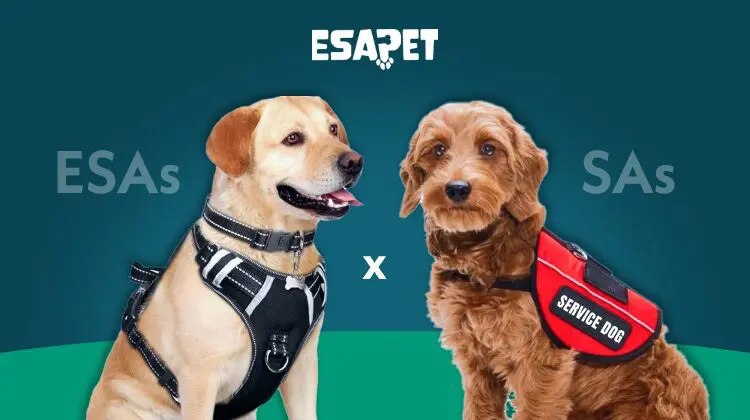
Service Dog vs Emotional Support Dog Laws
A service dog is legally recognized under the ADA when trained to perform specific tasks related to an individual’s disability, such as alerting to seizures or guiding a person with visual impairments. These dogs are granted public access rights and may accompany their handlers nearly everywhere.
In contrast, an emotional support dog offers psychological comfort through companionship but lacks specialized task training. ESAs are not recognized as service animals under the ADA or ACAA. However, under the FHA, they may qualify as necessary support for housing accommodations.
Psychiatric service dogs (PSDs) sit in a middle ground. They are task-trained—e.g., interrupting panic attacks—and are legally considered service animals under ADA and ACAA. In everyday guidance, these are often referred to as psychiatric service animals, but under the ADA they are typically service dogs trained to perform specific tasks.
What Disabilities Qualify for an Emotional Support Animal?
To qualify for an ESA, an individual must have a disability as defined by federal law—specifically, a physical or mental impairment that substantially limits one or more major life activities, such as walking, working, or concentrating. Common qualifying conditions include anxiety, PTSD, depression, and phobias.
There must be a disability-related need for the ESA. This means the animal must alleviate symptoms or effects of the disability. If this need is not obvious, housing providers may request documentation from a licensed healthcare provider familiar with the individual’s condition.
If the need is not obvious, housing providers may request reliable documentation from a licensed mental health professional familiar with the individual’s condition.
What are Emotional Support Animal Rights?
The FHA mandates that housing providers offer reasonable accommodations to individuals with disabilities who have a legitimate need for an ESA. This often leads to common questions such as can you have two emotional support animals, which depends on whether each animal is necessary to alleviate distinct symptoms of a disability. This includes waiving pet bans, breed restrictions, and extra pet fees.
Outside of housing, ESAs have no legal right to public access under the ADA. Businesses are not required to admit ESAs. Airlines may also deny ESA travel under the updated ACAA, treating them as pets instead of service animals.
Some states reinforce federal law by protecting ESA housing rights and penalizing misrepresentation or fraudulent documentation.
What to Do If Your ESA Rights Are Violated?
If a landlord or housing provider unlawfully denies ESA accommodation:
- File a complaint with HUD (U.S. Department of Housing and Urban Development).
- Contact the U.S. Department of Justice or a state civil rights agency (e.g., California Civil Rights Department).
- Seek legal representation to pursue civil litigation for discrimination.
Documentation and credible evidence will be critical. Ensure that the healthcare professional providing the ESA letter meets all applicable ESA letter legal requirements, as failure to do so may lawfully justify denial based on documented ESA restrictions under federal or state law.
Note: Depending on the issue, you may need to contact different federal agencies or a state civil rights office, so keep copies of your request and supporting documentation.
Responsibilities of an Emotional Support Animal Owner?
ESA ownership carries legal and ethical responsibilities, even though the animal does not need specific training.

Behavior and Control
The ESA must be well-behaved, housebroken, and not pose a threat. Landlords may remove animals that are dangerous or disruptive.

Supervision
The owner is solely responsible for the animal’s care and supervision; housing providers are not obligated to assist.

Damage Liability
ESA owners may be held liable for any damage caused by the animal to the property or other tenants.

Vaccination and Licensing
Compliance with local licensing and vaccination laws is mandatory.
What is Emotional Support Animal Training?
ESAs do not require formal training. Their role is to alleviate psychological distress through presence and companionship. However, good behavior and basic obedience are often expected, especially in housing situations.
Unlike service animals, which must be trained to perform specific disability-related tasks, ESAs offer passive emotional support. No federal or state law mandates specialized ESA training.
Emotional Support Animal Registration and Certification
There is no federal registry or certification requirement for emotional support animals. Online registration services offering ID cards or certificates have no legal authority.
What matters is documentation from a licensed mental health professional (or other qualified clinician) who can confirm:
- The individual’s disability.
- The therapeutic role of the ESA in mitigating symptoms.
Documentation is particularly necessary when the disability or need is not immediately observable. Housing providers are prohibited from requiring specific forms, notarized letters, or medical records disclosing diagnoses.
FAQ – Emotional Support Animal Laws
Yes—but only in housing under the Fair Housing Act. ESAs do not have public access rights under the ADA, nor do they qualify as service animals for air travel under the ACAA.
The FHA classifies ESAs as “assistance animals.” Housing providers must grant reasonable accommodations to tenants with disabilities who need an ESA. Providers may not:
- Charge pet fees.
- Impose breed or weight restrictions.
- Deny accommodation based on a “no pets” policy.
Denial is only permissible if the ESA poses a documented threat or causes undue burden.
Yes, you can have more than one emotional support animal if you can demonstrate a legitimate disability-related need for each one. Under federal housing law, landlords must assess accommodation requests individually and cannot deny multiple ESAs solely based on number, provided proper documentation supports the need.
Yes an apartment can deny an ESA, but only if:
- The ESA poses a direct threat to others’ health or safety.
- The accommodation causes undue financial or administrative burden.
- The animal’s presence would fundamentally alter the housing provider’s services.
Each case must be assessed individually. Generalized fears about breed, size, or stereotypes do not justify denial.
Yes, landlords can deny ESA requests only under limited, legally justifiable circumstances, such as property damage history or health threats from the specific animal.
Six states have enacted statutes to curb fraudulent ESA documentation by requiring an established provider-patient relationship:
- California: Requires a 30-day clinical relationship and a written notice from ESA sellers (Health & Safety Code § 122318).
- Montana: Mandates a 30-day relationship and clinical evaluation (MCA 70-24-114; 70-33-110).
- Florida: Prohibits letters from “online-only” providers; requires one in-person or telehealth appointment (Fla. Stat. § 760.27).
- Iowa: Requires a 30-day relationship with a treating provider (Iowa Code § 216.8C).
- Arkansas: Documentation must come from an established, treating provider (Act 268, § 20-14-1003).
- Colorado: Provider must have met the patient, be licensed, and qualified to assess disability needs (CRS § 12-245-229).
These laws enhance ESA legitimacy while upholding the FHA standard for “reliable third-party documentation.”
There is no federal limit on how many emotional support animals a person may have. Under the Fair Housing Act, a housing provider must consider requests for multiple ESAs if each animal is necessary to alleviate a distinct symptom or effect of the person’s disability. A person with multiple qualifying disabilities, or a single disability with multiple documented animal-related needs, may request more than one ESA.
Housing providers may request documentation for each animal. A single ESA letter that addresses multiple animals is acceptable if it explains the disability-related need for each one specifically. Requests for an unusually large number of animals may prompt the housing provider to request additional documentation establishing that each is individually necessary.
ESA letters are not inherently state-specific — a letter issued by a licensed mental health professional in one state is generally valid for housing purposes in another state, because the Fair Housing Act is a federal law that applies nationally.
Some states have added procedural requirements for how ESA letters must be issued. California, Montana, Iowa, Arkansas, and Florida require that the provider have an established therapeutic relationship with the client (typically 30 days) before issuing the letter. Florida additionally prohibits reliance on online-only providers without a valid telehealth relationship. A letter issued in a state without these requirements may still be accepted in a state that has them, but the housing provider in that state may scrutinize whether the letter meets the local standard. When in doubt, obtaining a letter that meets the strictest applicable state requirement is the safest approach.
Navigating Your Rights Under States’ ESA Laws
Understanding details of emotional support animal laws in each state is essential to protecting your rights and ensuring your emotional support animal is recognized where you live. While federal law like the Fair Housing Act provides baseline fair housing protections, state-specific regulations can vary — from documentation requirements to enforcement rules and complaint procedures. Knowing how these laws apply helps prevent discrimination and strengthens your housing request.
Remember, valid documentation from a licensed mental health professional is your strongest safeguard under federal law. Emotional support animals do not require special training or to perform tasks like a service animal or service dog, but the documentation must clearly connect the animal to your mental health condition and disability. Avoid unofficial registrations or websites promising instant certification without proper evaluation.
If you face challenges from a housing provider, document your accommodation request carefully and seek additional information from trusted sources such as the Department of Housing and Urban Development or the ADA National Network. With accurate documentation and a clear understanding of emotional support animal laws, you can confidently secure the housing accommodations your emotional support animal provides.
 Get Your ESA Letter Now

Update Notes
Mar. 10, 2026: This article was updated to reflect current emotional support animal laws.
Feb. 18, 2026: This article was medically reviewed by Joanna Martin

Emotional Support Animal, ESA and Service Animal Rights
Emotional Support Animal (ESA): Definiti...

Sandra Carretero
Jan 22 2026

Service Animals, ESA and Service Animal Rights
How to Get a Service Dog: Legal Rights, ...

Jonalyn Dionio
May 26 2026